
At a glance
| Typical condo value, ZIP 02116 | $1,298,982 (Zillow, August 2026) |
|---|---|
| Typical condo value, ZIP 02115 | $894,042 (Zillow, August 2026) |
| Typical condo value, ZIP 02199 (towers) | $4,168,272 (Zillow, August 2026) |
| First condo conversion in Boston | Back Bay, November 1969 |
| Replacement reserve fund | Required for every Massachusetts condominium (M.G.L. c. 183A s. 10) |
| 6(d) certificate turnaround | 10 business days after a written request |
What is a Back Bay brownstone condo?
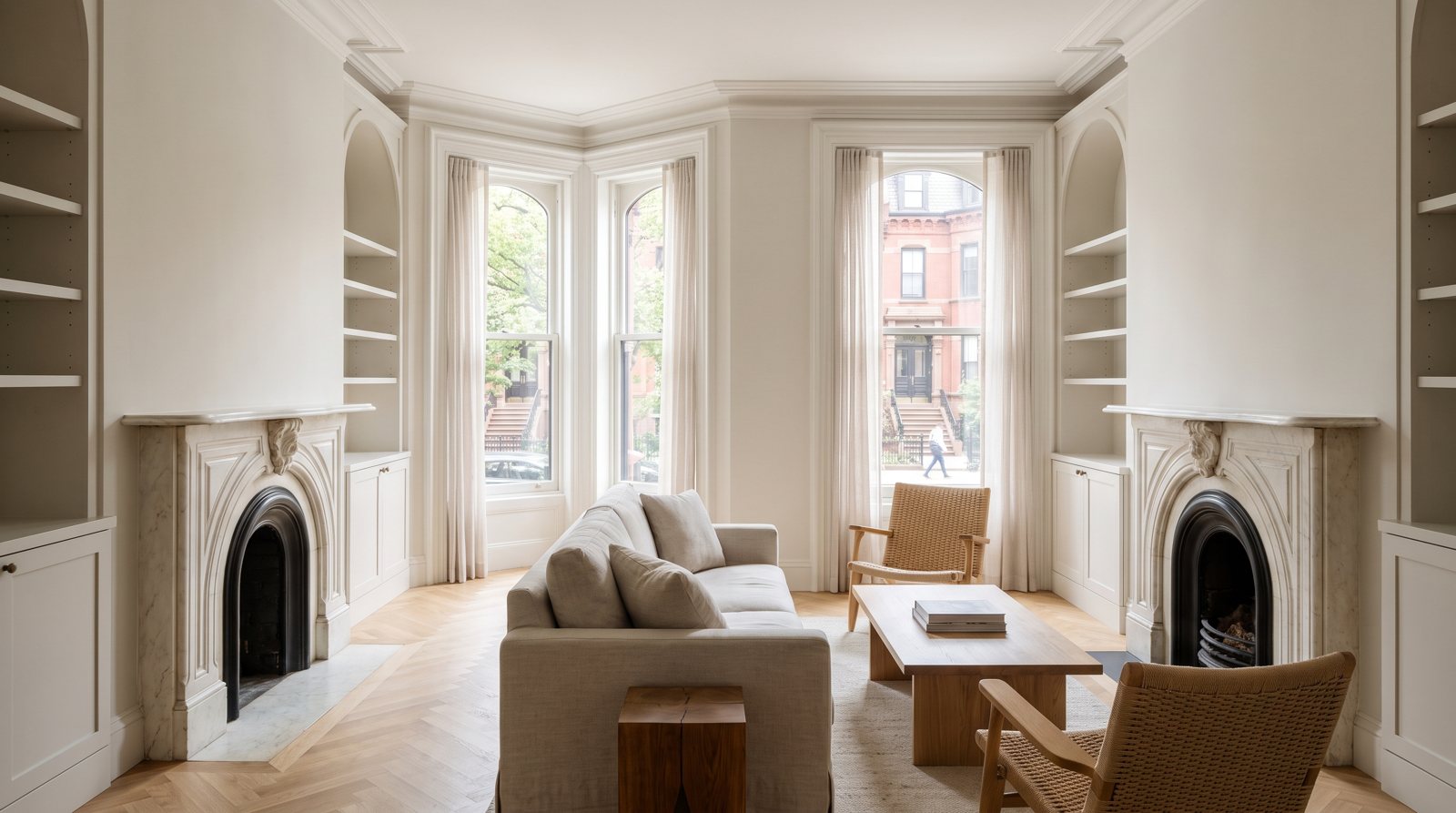
A Back Bay brownstone condo is a unit inside one of the neighborhood's 19th-century rowhouses. Back Bay Houses, the house-by-house history of the neighborhood, counts 1,156 buildings constructed on the originally vacant lots of the residential district, and most were built as single-family houses. After World War I many became lodging houses, apartments, dormitories and offices, a trend that deepened through the Depression and World War II.
Boston's first conversion of an existing residential building into condominiums took place in Back Bay in November 1969. Back Bay Houses calls condominium conversion probably the single most important innovation that kept the original buildings in residential use. The result is the market you see today: small associations of a handful of units sharing one facade, one roof and one budget.
On this site "brownstone" means these rowhouses in the everyday sense. Many are red brick with brownstone trim rather than solid brownstone fronts, so judge the building, not the label. If you want the whole building instead of one floor, see single-family Back Bay townhouses.
Types of condo units in a brownstone building
Because each building was designed as one house, units are cut from the original floors. The same building can hold units that differ sharply in light, ceiling height, outdoor space and stairs. These are the four layouts you will see most in listings.
Floor-through units
A floor-through takes one whole floor of the house, with windows at the street front and at the rear facing the alley. You get light from two sides and rooms that keep the proportions of the original house. Ask which floor it is, whether the building has an elevator and how the original rooms were divided when the building was converted.
Duplex units
A duplex spans two floors joined by an interior stair, for example two lower floors or the top floor and the level beneath it. Duplexes give more separation between living and sleeping space. Check that both levels are described in the unit deed and floor plans, because the deed and plans define what you own.
Garden-level units
The garden level is the lowest floor, at or slightly below the sidewalk. Back Bay lots were filled to five feet below the Mill Dam so cellars would not need to be dug, and the original deed restrictions barred cellars more than four feet below the Mill Dam level. Because these floors sit closest to the groundwater that protects the building's wood piles, ask the trust for any foundation or pile reports and any history of water entry.
Penthouse and top-floor units
Top-floor units trade stairs for light and, sometimes, a roof deck. In the Back Bay Architectural District a roof deck needs design approval: the Commission's guidelines say decks should be minimally visible from any public way, set back to the inward edge of the chimneys and kept close to the roof, and decks on top of roof additions are inappropriate. Ask whether an existing deck has approval, and read the rules for exterior work and roof decks before you plan one.
What do Back Bay condos cost?
Zillow publishes typical values by ZIP code and neighborhood, not by street, building or unit type. These are its August 2026 condo figures for the ZIP codes that cover Back Bay.
| Area | Typical condo value (Aug 2026) | 12-month change, condos | 10-year change, condos | Typical value, all homes | 12-month change, all homes |
|---|---|---|---|---|---|
| ZIP 02116 | $1,298,982 | +3.4% | +24.9% | $1,355,771 | +0.6% |
| ZIP 02115 | $894,042 | +0.8% | +22.5% | $933,201 | -5.4% |
| ZIP 02199 (towers) | $4,168,272 | +3.2% | +0.9% | $3,619,095 | -2.3% |
| Back Bay neighborhood | n/a | n/a | n/a | $1,340,764 | -2.2% |
02116 is Back Bay's main ZIP and holds most of the brownstone blocks. 02115 is shared with the Fenway and Longwood areas, so its lower figure mixes in a different housing stock. For the full split, see how the Back Bay ZIP codes differ.
Are Back Bay condo prices falling?
Not in the main ZIP, by Zillow's measure. Its typical 02116 condo value rose 3.4% in the 12 months to August 2026 and 24.9% over ten years, while the all-homes figure for the Back Bay neighborhood fell 2.2% over the same year. The two series cover different areas and home mixes, so read them side by side rather than as one trend.
Regional sales data points the same way. In the Greater Boston Association of REALTORS territory, a much wider area than Back Bay, the median condo sale price was $725,000 in August 2026, up 3.7% from a year earlier. Condos there sold for 97.7% of original list price after a median 47 days on market, with 3.2 months of supply.
Tower condos in 02199 are a different product
ZIP 02199 is the Prudential Center area, dominated by towers. Its typical condo value of $4,168,272 describes high-rise units, not rowhouse floors, so do not use it to price a brownstone unit. No public source publishes typical prices by floor or unit type inside brownstones; a floor-through and a penthouse in the same building can sell far apart. Comparable sales on your block and floor are the only reliable guide, and the Back Bay market trends page tracks the neighborhood figures over time.
Condo fees, reserves and special assessments
Every unit owner pays a share of the building's common expenses, usually as a monthly fee set by the trust's budget. No official source publishes typical Back Bay condo fees, and in a small brownstone association the number depends on the roof, facade, heating system and insurance of that one building.
What the monthly fee pays for
The fee funds the operating budget and the reserve. Under M.G.L. c. 183A s. 6(a)(ii), the association may charge the cost of maintaining, repairing or replacing a limited common area, such as a deck or parking space assigned to one unit, solely to the owner of the unit it serves. Ask the trust for the current monthly charge and what it covers.
Replacement reserve rules
Section 10 of chapter 183A says all condominiums "shall be required to maintain an adequate replacement reserve fund", collected with the common expenses and held in accounts separate from operating funds. After the developer hands over control, owners can modify the requirement by an annual vote of 67% of the beneficial interest. A Massachusetts real estate attorney's condo buying guide suggests, as a rule of thumb rather than a legal rule, that the reserve hold at least 10% of the annual revenue budget, and more for older buildings.
Special assessments and the condo lien
The same guide warns that a poorly funded reserve raises the risk of a special assessment. Unpaid charges become a lien on the unit, and for up to six months of budgeted assessments plus collection costs that lien takes priority over a first mortgage under c. 183A s. 6(c). That is why lenders require a 6(d) certificate and the condo documents before closing.
Owning costs on a 02116 condo
Take a unit priced at Zillow's typical 02116 condo value of $1,298,982 and assume, for illustration, that its assessment matched that figure. At Boston's FY2026 residential rate of $12.40 per $1,000, the bill would be about $11,753.64 a year for an owner-occupant with the $351,108 residential exemption, or $16,107.38 without it. Boston says the exemption saved qualified owners up to $4,353.74 in FY2026; the Boston property tax guide covers eligibility and deadlines. FY2027 rates are set in December 2026.
Financing matters too. With 20% down, the loan on that unit would be about $1,039,186, above the FHFA 2026 one-unit conforming limit of $962,550 for Suffolk County, so it would be a jumbo loan. Lenders also review the condo project itself; see jumbo mortgages in Massachusetts for how that works. Freddie Mac's 30-year fixed average was 7.28% in the week of October 1, 2026.
What to check before buying a brownstone condo
- The trust's paperwork. Master deed and amendments, declaration of trust and bylaws, rules, current and prior-year budgets, reserve balance and any reserve study, recent minutes, and any planned special assessment or litigation.
- Lead paint. Every original Back Bay rowhouse predates 1978. Ask for inspection reports and any letters of compliance, and read how the Massachusetts lead law applies to a purchase.
- Architectural Commission status. The Commission will not approve new applications while violations are outstanding, and in a multi-owner building it treats the whole building uniformly. Ask whether any violations are open.
- Foundations and groundwater. Back Bay buildings rest on wood piles that must stay below groundwater. Check the Boston Groundwater Trust's observation wells near the building and ask for pile or underpinning records.
- Parking. Confirm whether any space is deeded, a limited common area or leased; the guide to parking for Back Bay owners covers the options.
- Insurance. Ask what the master policy covers so you can size your own unit policy.
Pros and cons of a brownstone condo
Pros
- An entry price well below a whole house: Zillow's typical 02116 condo value is $1,298,982 against $1,818,983 for a single-family home.
- Original rooms, ceiling heights and street-facing bays inside a protected historic district.
- Shared costs for the roof, facade and structure, funded through a required reserve.
Cons
- Small associations have few owners to share a large repair, so one roof or masonry project can mean a special assessment.
- Exterior changes, windows and roof decks need Commission approval, and the whole building is treated as one.
- An elevator and a deeded parking space cannot be assumed; a 2024 Boston Globe report put single Back Bay spaces in the hundreds of thousands of dollars.
Selling a Back Bay condo
If you own a unit, its value turns on the same things a buyer checks: block, floor, light, outdoor space, parking and the trust's finances. Order the 6(d) certificate early and gather the lead paperwork before you list. Compare Back Bay streets block by block, from the 200-foot-wide boulevard of Commonwealth Avenue to quieter side streets, then read what selling a brownstone unit involves. For a starting number, our recommended Back Bay agent can pull recent condo sales on your block.
Frequently asked questions
How much does a condo cost in Back Bay, Boston?
Zillow's typical condo value in ZIP 02116, Back Bay's main ZIP, was $1,298,982 in August 2026. In 02115, which is shared with the Fenway and Longwood areas, it was $894,042. Tower condos in 02199 averaged $4,168,272, but those are a different product. Zillow publishes no value by street, building or floor, so comparable sales are the guide for a specific unit.
Is Back Bay the richest neighborhood in Boston?
Measured by home values, Back Bay is among Boston's highest. Zillow's typical home value for the Back Bay neighborhood was $1,340,764 in August 2026, against $1,105,539 for Beacon Hill, $1,080,575 for the South End and $774,723 for the City of Boston as a whole. The Prudential Center ZIP, 02199, was higher at $3,619,095, driven by towers.
Is Back Bay a good part of Boston to buy a condo?
That depends on what you need from a home, but the facts are clear. Back Bay is a protected architectural district with 19th-century rowhouses on a planned street grid, the Commonwealth Avenue Mall and the Public Garden at its edge. Typical 02116 condo values were $1,298,982 in August 2026, and Back Bay's neighborhood value rose 18.7% over ten years versus 38.5% for Boston.
What is the famous street in Back Bay, Boston?
Commonwealth Avenue is the best known residential street: a 200-foot-wide boulevard with a 100-foot central mall running from the Public Garden toward the Back Bay Fens. Newbury Street is known for shops, and its rowhouses are now largely in commercial or mixed use. Beacon and Marlborough Streets complete the main residential grid.
How much are condo fees in Back Bay brownstones?
No official source publishes typical fees. In a small brownstone association the monthly charge depends on that building's budget: insurance, heat, roof and masonry work, cleaning and the replacement reserve that Massachusetts law requires. Ask the trust for the current monthly charge, the reserve balance and whether any special assessment is planned or under discussion.
Do I need a jumbo loan for a Back Bay condo?
Often, yes. FHFA's 2026 conforming limit for a one-unit home in Suffolk County is $962,550. With 20% down on a unit at Zillow's typical 02116 condo value of $1,298,982, the loan would be about $1,039,186, above that limit. Lenders also review the condo project, including its budget, insurance and any litigation.
What documents should I get when buying a Back Bay condo?
Ask for the master deed and amendments, the declaration of trust and bylaws, the rules, current and prior-year budgets, the reserve balance and any reserve study, recent meeting minutes, and notice of any planned special assessment or litigation. At closing the association's 6(d) certificate confirms what the unit owes in unpaid charges.
What's the zip code for Back Bay?
Back Bay's main ZIP code is 02116, used by addresses such as Back Bay station at 145 Dartmouth Street and the Central Library at 700 Boylston Street. Parts of the area use 02115, which is shared with the Fenway and Longwood areas, and the Prudential Center uses 02199, a ZIP dominated by towers rather than brownstones. Most of the brownstone blocks fall in 02116.
Are condo prices in Boston dropping?
Not by the latest figures. Zillow's typical condo value in Back Bay's main ZIP, 02116, was $1,298,982 in August 2026, up 3.4% from a year earlier. Across the Greater Boston Association of REALTORS territory, the median condo sale price was $725,000 in August 2026, up 3.7%. Individual buildings and floors can still sell below their last price, so check recent sales in the same building.
Sources
- Zillow Home Value Index (ZHVI), August 2026, via tools/data/backbay.json
- Back Bay Houses: Back Bay Development, 1910-2015
- Back Bay Houses: Frequently asked (or should be asked) questions
- Back Bay Houses: Overview: Development of the Back Bay
- Back Bay Houses: Back Bay Deed Restrictions
- City of Boston: Back Bay Architectural Commission, Guidelines for the Residential District (PDF)
- malegislature.gov: M.G.L. c. 183A, Section 6
- malegislature.gov: M.G.L. c. 183A, Section 10
- Vetstein Law Group (Massachusetts Real Estate Law Blog): Condominium Buying Guide
- Boston Groundwater Trust: Groundwater & Building Foundation Data
- City of Boston Assessing: How we tax your property
- City of Boston Assessing: Residential exemption
- FHFA: Conforming loan limits for 2026, full county list
- Freddie Mac: Primary Mortgage Market Survey
- Friends of the Public Garden: The Mall
- The Boston Globe (via Boston.com): $500,000 for a parking spot? Inside the world of exclusive parking in Boston (May 2024)
- Wikipedia: Back Bay, Boston
- Greater Boston Association of REALTORS: Monthly market statistics, August 2026 (PDF)
- MBTA: Back Bay station
- Boston Public Library: Central Library
- Prudential Center: Contact us