
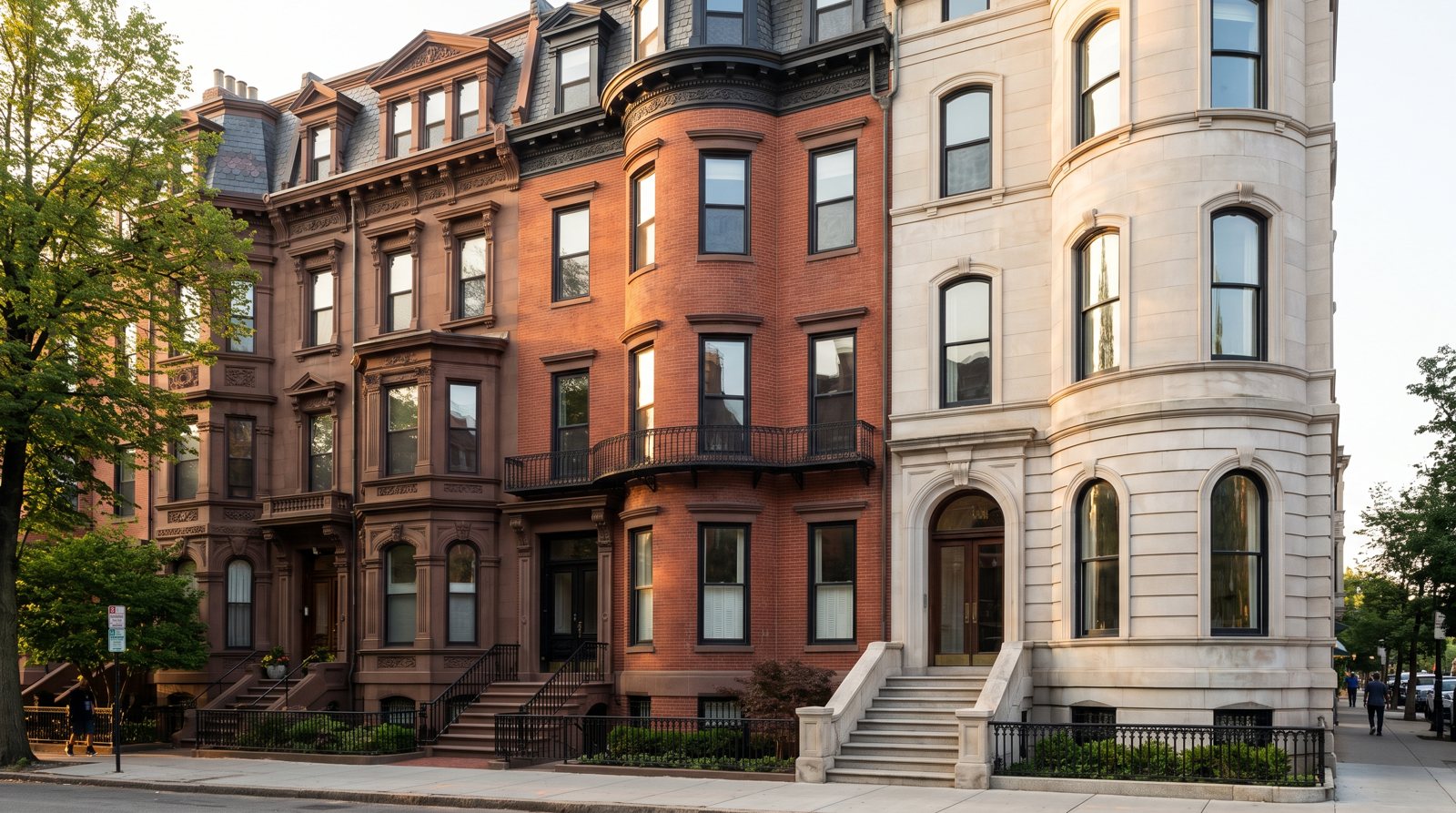
What is a brownstone in Boston?
Merriam-Webster gives two meanings: a reddish-brown sandstone used for building, and a dwelling faced with it. In everyday use the word stretches further, to rowhouses in general, including brick buildings with no brownstone at all. Boston uses it the same loose way, and so does this site. For the stone, the term and how it differs from a townhouse, see the brownstone definition.
Brownstone fronts and brick houses
Connecticut Explored traces the brownstone fronts of Back Bay row houses to the quarries at Portland, Connecticut, which also supplied Brooklyn, Manhattan and Philadelphia. Yet many Back Bay houses are red brick with brownstone trim. The Gibson House museum on Beacon Street shows the early pattern: brownstone at the basement and first floor, brick with brownstone trim above. A City historic-districts official has said early Back Bay buildings often used brownstone, while later ones drew on London and, by the 1890s, on colonial and federal models.
Condos and whole houses
Most Back Bay buildings went up as single-family houses. After World War I many were divided into apartments and lodging houses, and Boston's first condo conversion of an existing residential building took place in the Back Bay in November 1969. Today you buy either a unit, covered in Back Bay brownstone condos, or a whole house, covered in single-family townhouses in Back Bay.
Layout terms in Boston listings
Listings describe brownstone homes by floor, and the same few words come up again and again. Knowing them makes two prices easier to compare.
- Stoop: the outside stair up to a raised front door. Wikipedia traces the word to the Dutch stoep.
- Garden level or English basement: the lowest floor, at or a little below the sidewalk. Back Bay lots were filled to five feet below the Mill Dam so cellars would not need to be dug, and the original deeds barred cellars more than four feet below that level, so these floors are shallow rather than deep basements.
- Parlor floor: the raised floor reached from the stoop, which held the house's main reception rooms.
- Floor-through: a unit taking one whole floor, with windows on the street and on the rear alley.
- Duplex or triplex: a unit on two or three floors joined by an inside stair.
How each of these trades light, stairs and outdoor space is set out in the guide to unit types in Back Bay brownstones.
Back Bay, Beacon Hill and the South End compared
All three are City of Boston historic districts, and the City lists all three among the neighborhoods whose buildings stand on wood piles. They differ in age, plan, style and how their commissions review exterior work.
| Neighborhood | City historic district | Main building era | Character (per sources) | Zillow typical value, Aug 2026 | 12-month change |
|---|---|---|---|---|---|
| Back Bay | Back Bay Architectural District, 1966 | 1856 to the early 1900s | Planned grid on filled land; brownstone and brick | $1,340,764 | -2.2% |
| Beacon Hill | Historic Beacon Hill District, 1955 | Early 19th century | Federal and Greek Revival | $1,105,539 | +3.3% |
| South End | South End Landmark District, 1983 | About 1850 to 1880 | Long uniform Victorian rows; Italianate predominant | $1,080,575 | +2.0% |
Back Bay
Back Bay was tidal flats until filling began in the fall of 1857. An 1856 plan set five east-west streets crossed by alphabetical cross streets, with Commonwealth Avenue widened to a 200-foot boulevard, and building moved east to west from the Public Garden. Back Bay Houses counts 1,156 buildings on the original lots. The story of how the Back Bay was filled and built has the full timeline.
Beacon Hill
Beacon Hill grew after the Bulfinch-designed State House was completed in 1798, and the City describes its houses as Federal and Greek Revival from the early 19th century. Its district was established in 1955 and expanded in 1958, 1963, 1975 and 2024. Those styles predate brownstone's rise in popularity through the mid-1800s, so on the Hill the word usually means a historic rowhouse rather than a stone facade.
South End
The City says South End development began in 1850 with single-family rowhouses built in long uniform rows; its Landmark District was designated in 1983. The National Trust's architectural trust calls it the largest assembly of Victorian row homes in the United States, with Italianate the predominant style, and Wikipedia puts the district at over 300 acres.
Back Bay vs Beacon Hill
Beacon Hill is the older of the two, with Federal and Greek Revival houses; Back Bay's houses were built from 1856 onward on a planned grid. The two commissions also differ in scope: Beacon Hill's reviews exterior work visible from a public way, while Back Bay's reviews all exterior work, including alterations not visible from the street. By Zillow's August 2026 figures, Back Bay's typical value was $235,225 higher.
Back Bay vs the South End
The two were built in overlapping decades, but the South End is laid out in long uniform rows while Back Bay is organized around the Commonwealth Avenue Mall and the river-side blocks of Beacon Street. Zillow's August 2026 typical value was $260,189 higher in Back Bay, though the South End rose 2.0% over the year while Back Bay fell 2.2%.
How Back Bay's brownstone blocks are laid out
Five streets and eight cross streets
Beacon, Marlborough, Commonwealth, Newbury and Boylston run east-west, crossed by Arlington, Berkeley, Clarendon, Dartmouth, Exeter, Fairfield, Gloucester and Hereford. Beacon, Marlborough and Commonwealth each have nine residential blocks from Arlington Street to Charlesgate East. The street-by-street guide to Back Bay covers each one.
Front setbacks and rear alleys
The original deeds set front setbacks of 20 feet on Commonwealth and 22 feet on Marlborough, Newbury and the south side of Beacon, and required a 16-foot alley behind the lots. A City preservation official has explained that the alleys kept delivery wagons off the main streets, which let front yards be developed.
Built from east to west
The first houses went up on the north side of Beacon between Arlington and Berkeley in 1856 and 1857. Construction peaked in 1870 to 1872, reached west of Massachusetts Avenue in the early 1880s, added apartment houses in the 1890s, and ended for single-family houses on original lots in 1908.
Are Boston brownstones expensive?
By Boston standards, yes. Zillow publishes no brownstone-only figure, but its August 2026 typical value in ZIP 02116, Back Bay's main ZIP, was $1,298,982 for condos and $1,818,983 for single-family homes, against $774,723 for the City of Boston and $733,574 for the Boston metro.
Ten-year change
From August 2016 to August 2026, Zillow's Back Bay typical value rose 18.7%, while the City of Boston figure rose 38.5%. Over that decade, Back Bay values grew at about half the city's rate.
Financing and tax at Back Bay prices
FHFA's 2026 conforming limit for a one-unit home in Suffolk County is $962,550. A 02116 condo at Zillow's typical value with 20% down needs a loan of about $1,039,200, above that limit, so it would be a jumbo loan; Freddie Mac's 30-year fixed average was 7.28% in the week of October 1, 2026. At Boston's FY2026 rate of $12.40 per $1,000, the same condo assessed at that value and owner-occupied would pay about $11,753.64 a year after the residential exemption. Try your own figures in the jumbo loan calculator.
If you already own one, values move block by block; what your Back Bay home could sell for explains how a price is set.
What is special about a brownstone?
The stone
Brownstone gets its color from iron in the sandstone, which rusts and coats the sand grains. Wikipedia describes it as easy to quarry and carve but prone to weathering: water and salt get into its layers and, as they freeze and crystallize, make the face spall.
A continuous street wall
The Back Bay Architectural Commission's guidelines say the district has a consistency of character, form and scale set by the original deed limits on height, setback and materials: a continuous street facade, regular cornice lines and a repeating pattern of bays and oriel windows.
Protected exteriors
The Back Bay was listed on the National Register of Historic Places in 1973, and demolition of historic structures is prohibited in the residential portion of its architectural district. Windows, masonry, roof decks and paint all go through design review.
Wood pile foundations
Back Bay houses rest on wooden piles driven through the fill, which stay sound only while groundwater covers them. The Boston Groundwater Trust, created by the City Council in 1986, says it protects more than 8,000 historic buildings on wood piles and tracks more than 800 monitoring wells.
Costs of owning a Boston brownstone
The price is only the start. A 19th-century masonry building in a historic district carries running costs that a newer building may not, and they differ between a condo and a whole house.
Condo fees and reserves
Massachusetts requires every condominium to keep an adequate replacement reserve, held apart from operating funds. One Massachusetts real estate attorney suggests a reserve of at least 10% of the annual budget as a rule of thumb, and more for older buildings, because a thin reserve raises the risk of a special assessment. The association may also charge the upkeep of a limited common area, such as a deck or parking space, solely to the unit it serves. Ask the trust for the current fee and any planned assessment.
Exterior upkeep under design review
Masonry cleaning and repair need Commission review before work starts. Sandblasting, wire brushing and other abrasive methods are not allowed, new mortar must match the original with a high sand and lime content, and replacement stone must approximate brownstone in composition, appearance and texture. Replacement windows should generally be double-hung wood sash. Budget for specialist trades and for the monthly hearing calendar.
Insurance
NerdWallet's analysis puts the average Boston homeowners policy at about $2,395 a year, an estimate for a house policy rather than a condo unit policy. A whole house needs a full homeowners policy; a condo owner relies on the association's master policy plus a unit policy. Get quotes on the specific building, since averages do not predict a price.
What to check before buying a Boston brownstone
- Ask whether the building has open Architectural Commission violations; no new application is approved while they remain.
- If a roof deck matters, confirm it was approved and check how visible it is from streets and alleys.
- Look up the nearest Boston Groundwater Trust wells and ask for any pile or foundation reports.
- For a condo, read the 6(d) certificate, budget, reserve balance and minutes, and ask about planned special assessments.
- Ask for lead inspection reports and any letters of compliance or interim control.
- Book a general inspection with roof access, and for a whole house or a building facing facade work, add masonry, roofing and chimney specialists.
- Ask the age and service history of the heating system, wiring and plumbing, and whether past work was permitted.
- Confirm in writing whether a parking space is deeded, assigned as a limited common area or leased.
- If you plan to add more than 50 square feet, excavate 8 feet or deeper, or substantially rehabilitate the building, expect Boston's Groundwater Conservation Overlay District rules: a recharge system and an engineer's certification of no harm to groundwater.
- For a pile cutoff elevation or original construction details, check the 1879 to 1903 Building Inspection Reports held by the Boston Public Library's Fine Arts Department.
The Commission's rules for windows, masonry and decks are summarized in the brownstone renovation guide.
Frequently asked questions
What is a brownstone in Boston?
Strictly, a brownstone is a house faced with reddish-brown sandstone. In Boston the word is used loosely for the 19th-century masonry rowhouses of Back Bay, the South End and Beacon Hill, including many red brick houses with brownstone trim or none at all. Back Bay's brownstone fronts came largely from the quarries at Portland, Connecticut.
Are Boston brownstones expensive?
Yes, by Boston standards. Zillow's typical home value in August 2026 was $1,340,764 for the Back Bay neighborhood, with $1,298,982 for condos and $1,818,983 for single-family homes in ZIP 02116, against $774,723 for the City of Boston. At those values, a purchase with 20% down needs a loan above Suffolk County's $962,550 conforming limit.
What is so special about a brownstone?
The carved reddish-brown stone, the continuous street wall of matching heights and cornices, and the protection of a historic district. In Back Bay, an architectural commission reviews all exterior work, demolition of historic houses is prohibited in the residential district, and the houses stand on wood piles that the Boston Groundwater Trust monitors.
Is Back Bay or Beacon Hill more expensive?
By Zillow's August 2026 typical home values, Back Bay was higher at $1,340,764 against $1,105,539 for Beacon Hill. Beacon Hill rose 3.3% over the year while Back Bay fell 2.2%. These are neighborhood-wide figures for all home types, so compare recent sales of similar homes before drawing conclusions about a particular house or unit.
Are there brownstones in the South End?
Yes. The South End's rowhouses were built from about 1850 in long uniform rows, and the National Trust's architectural trust calls the district the largest assembly of Victorian row homes in the United States, with Italianate the main style. Its Landmark District was designated in 1983. Zillow's typical South End value was $1,080,575 in August 2026.
Where are the brownstones in Boston?
The main concentrations are Back Bay, between the Public Garden and Charlesgate East; the South End; and Beacon Hill, though many houses in all three are brick rather than brownstone. In Back Bay they line Beacon Street, Marlborough Street, Commonwealth Avenue and the cross streets from Arlington to Hereford, with Newbury Street's former houses now largely commercial.
Is $200,000 a good salary in Boston?
It is far above MIT's Suffolk County living wage for one adult with no children, $33.60 an hour or about $69,900 a year full time. Buying a brownstone is a harder test. On a 02116 condo at Zillow's August 2026 typical value of $1,298,982, with 20% down at 7.28%, principal and interest run about $7,110 a month, plus about $979 of FY2026 tax with the residential exemption. That $8,090 is about 49% of $200,000 gross monthly pay, before condo fees, above the 43% debt-to-income limit Experian says jumbo lenders typically use.
Is $80,000 a good salary in Boston?
It clears MIT's Suffolk County living wage for one adult with no children, $33.60 an hour or about $69,900 a year at full-time hours, so it covers a single person's basic costs as MIT measures them. It does not stretch to buying a Back Bay brownstone on one income: principal, interest and property tax on a typical 02116 condo come to about $8,090 a month, more than the roughly $6,667 that $80,000 pays before tax each month.
Sources
- Zillow Research: Home Values (ZHVI), neighborhood, ZIP, city and metro data, August 2026
- Merriam-Webster: brownstone
- Wikipedia: Brownstone
- Connecticut Explored: The Quarry That Built Boston and New York City
- National Park Service: Gibson House, National Historic Landmark registration form
- Boston.com: From Landfill to 'Work of Art': Back Bay Architectural District (Feb 5, 2015)
- Back Bay Houses: Frequently Asked Questions
- Back Bay Houses: Back Bay Development 1910-2015
- Back Bay Houses: Overview: Development of the Back Bay
- Back Bay Houses: Back Bay Deed Restrictions
- Back Bay Houses: Back Bay Development 1855-1859
- Back Bay Houses: Back Bay Development 1890-1899
- Back Bay Houses: Back Bay Development 1900-1909
- City of Boston: Back Bay Architectural District
- City of Boston: Historic Beacon Hill District
- City of Boston: South End Landmark District
- Architectural Trust: City and State: Boston, Massachusetts
- Wikipedia: South End, Boston
- City of Boston: Back Bay Architectural Commission, Guidelines for the Residential District
- Boston Groundwater Trust
- City of Boston: 40 Years Beneath the Surface: Honoring the Boston Groundwater Trust
- David B. Williams, Street Smart Naturalist: The Most Hideous Stone Ever Quarried
- FHFA: Conforming loan limits for 2026, full county list
- Freddie Mac: Primary Mortgage Market Survey
- City of Boston Assessing: How we tax your property
- City of Boston Assessing: Residential exemption
- malegislature.gov: M.G.L. c. 183A, Section 10
- malegislature.gov: M.G.L. c. 183A, Section 6
- Massachusetts Real Estate Law Blog: Massachusetts Condominium Buying Guide
- Boston Groundwater Trust: Article 32, Groundwater Conservation Overlay District
- Boston Groundwater Trust: Groundwater & Building Foundation Data
- NerdWallet: The best home insurance in Massachusetts in 2026
- Wikipedia: Stoop (architecture)
- MIT Living Wage Calculator: Suffolk County, Massachusetts
- Experian: What Is a Jumbo Loan?