
At a glance
| Runs | Arlington Street west to Charlesgate East, house numbers 1 to about 459 |
|---|---|
| Width | Planned 60 feet |
| Lot depth | 112 feet, with a 16-foot alley behind each side |
| Original setback | 22 feet on both sides |
| Built | Mostly 1860s to 1900s, east to west; west of Massachusetts Avenue from the early 1880s |
| Historic review | Back Bay Architectural Commission (residential portion) |
What is Marlborough Street like?
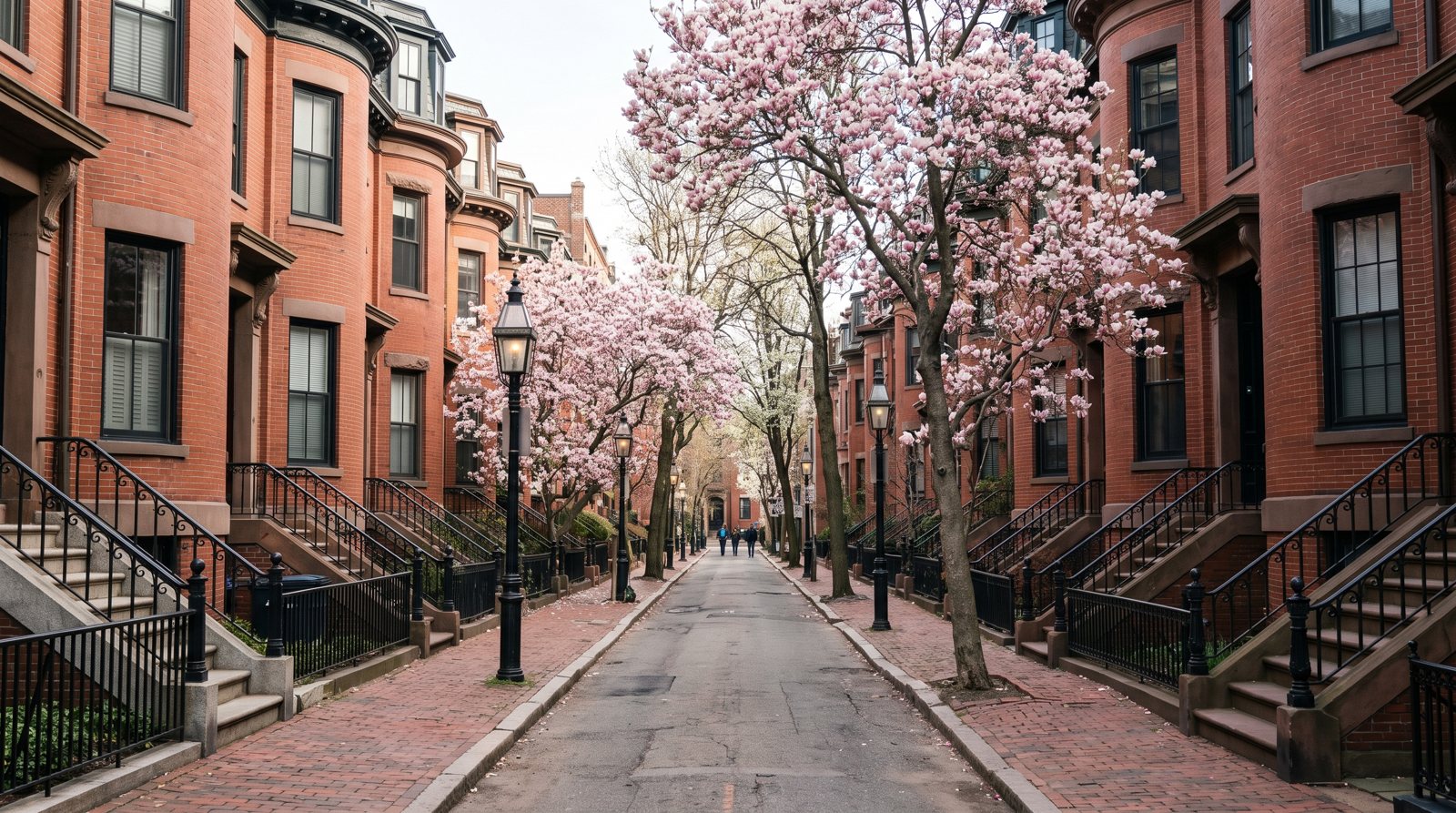
Marlborough Street (often written Marlboro) sits between Beacon Street and Commonwealth Avenue and runs the full width of the residential Back Bay, from Arlington Street to Charlesgate East. It appeared on the 1856 plan at 60 feet wide, the same as Newbury and narrower than Beacon (70 feet) or Commonwealth (200 feet), with a 22-foot front setback on each side. The result is a street of continuous house fronts set close together, with small front yards.
Every block has a 16-foot alley behind each side: one shared with the south side of Beacon, one with the north side of Commonwealth. Because the land north of Commonwealth was filled faster than the land to its south, Marlborough's blocks were ready for building earlier than those on the far side of the avenue. The whole street lies in the residential part of the Back Bay Architectural District, where demolition of historic buildings is prohibited.
Marlborough also marks the end of an era of loss: 99 original Back Bay buildings were demolished and replaced by 61 newer ones, and the last original buildings to come down, in 1967, were on Marlborough Street. The neighborhood's full building history is told on our Back Bay history and architecture page.
Marlborough Street homes and prices
Zillow publishes nothing for Marlborough itself, so use its ZIP 02116 figures as the reference: in August 2026 the typical value was $1,298,982 for a condo, $1,818,983 for a single-family home and $1,355,771 across all homes, up 0.6% over twelve months. These are mid-tier, ZIP-wide estimates rather than a price for any block or floor.
Condominiums by floor
Most Marlborough houses were built for one household and are now divided into a few condominium units, often one or two per floor. On a 112-foot lot the house is twelve and a half feet shallower than its counterpart on Commonwealth, which shows up in room depth. A condo near the 02116 figure would need a jumbo loan with less than about 26% down, because the 2026 conforming limit for Suffolk County is $962,550; the jumbo loan payment calculator runs the monthly numbers.
Whole houses
Some houses remain, or have returned to, single-family use. Their deeds once required at least three stories and brick, stone or other non-combustible walls, which is why the street has no wood houses. Expect a whole house here to be priced well above the 02116 single-family figure, which mixes in smaller homes across the ZIP.
Replacement buildings
Where originals were demolished, the lots were rebuilt with multi-unit buildings, as almost all Back Bay construction after 1910 was. These are larger condominium associations than a converted house, so read the budget, reserve fund and minutes as carefully as the unit.
Marlborough Street block by block
Back Bay Houses indexes Marlborough in nine blocks, with numbers running from 1 at Arlington to about 459 at Charlesgate East. Ranges are approximate.
Arlington to Berkeley (about 1 to 39)
The first block starts at the Public Garden, across 80-foot Arlington Street. Arlington station, three blocks south at Boylston, is the closest Green Line stop.
Berkeley to Clarendon (about 53 to 92)
The numbers jump between the first and second blocks, so a low address does not always mean the first block. Back Bay Houses gives each building's date and original owner if you want to date a house.
Clarendon to Dartmouth (about 103 to 148)
Clarendon Street runs south to Copley Square, where Trinity Church (1872 to 1877) stands. A Bluebikes dock is at Clarendon and Newbury, two blocks south.
Dartmouth to Exeter (about 163 to 199)
Dartmouth Street leads to Back Bay station at 145 Dartmouth and to the Logan Express stop at the Copley Place entrance across from it, where the bus to the airport costs $3 outbound and the return is free.
Exeter to Fairfield (about 220 to 279)
A long run of numbers for one block. The Back Bay's heaviest building years came in 1870 to 1872, when 207 buildings went up before the 1872 fire and the 1873 panic stopped work. A Bluebikes dock stands on Boylston at Exeter.
Fairfield to Gloucester (about 282 to 323)
Gloucester Street, at the west end of this block, is where Boston's condominium era started: the city's first conversion of an existing residential building took place on Gloucester Street in November 1969.
Gloucester to Hereford (about 334 to 362)
One of the shorter blocks by house count. Hereford is the last of the alphabetical cross streets laid out on the 1856 plan.
Hereford to Charlesgate East (about 363 to 459)
The two westernmost blocks straddle Massachusetts Avenue, which was called West Chester Park until 1894; the land was filled to it by 1881 and beyond it in the early 1880s. Hynes station at 100 Massachusetts Avenue serves the Green Line B, C and D branches. Charlesgate East, called Ipswich Street until 1887, ends the street at the Fens.
Parking and getting around
On-street parking runs on City permits. The City's resident permits cost nothing, but you need the car registered and principally garaged at your Boston address, all parking tickets paid, and the permit works only in your own neighborhood. If a sale includes a space, get its legal status in writing; a deeded space and a space assigned as a limited common area are owned and maintained differently. See how parking works in Back Bay for garages and costs.
Walk Score rates the Back Bay 97 for walking, 96 for transit and 87 for biking. From Marlborough, Arlington, Copley and Hynes Green Line stations and Back Bay station on the Orange Line and Commuter Rail are all within the grid.
Pros and cons of a Marlborough Street home
Pros
- A 60-foot residential street between two wider ones, entirely in the residential part of the district.
- Commonwealth Avenue's Mall one block south and the Esplanade a short walk north.
- A 22-foot original setback, giving each house a small front yard.
Cons
- Shallower 112-foot lots than Commonwealth's 124.5 feet.
- No front park or river view; outdoor space usually means a roof deck, which needs Commission approval (see Back Bay renovation and roof deck rules).
- Off-street parking is limited and priced separately from the home.
Marlborough Street compared with its neighbors
To the north, the Back Bay blocks of Beacon Street are wider, and the north side backs onto the river. To the south, Commonwealth Ave homes facing the Mall sit on deeper lots. The Back Bay street comparison lays out all of them, including the cross streets.
If you own on Marlborough and want a number before you decide anything, price your home against recent sales on the street; read about pricing and selling a Marlborough Street home.
Questions about Marlborough Street
What is the most famous street in Boston?
Boston has no official most famous street. In the Back Bay, Commonwealth Avenue is known for its 32-acre Mall, Newbury Street for its retail shops and restaurants, and Beacon Street for following the 1814 Mill Dam. Marlborough Street is the quieter residential street between Beacon and Commonwealth, 60 feet wide and lined with 19th-century rowhouses.
What is the wealthiest street in Boston?
No neutral source ranks streets by wealth or value, and Zillow publishes values only by ZIP code and neighborhood. In August 2026, Zillow's typical value for Back Bay's ZIP 02116 was $1,355,771 for all homes and $1,818,983 for single-family homes. For Marlborough Street prices, ask for MLS PIN closed sales on the block.
What is the most trendy street in Boston?
Trendiness is not measured by any official source. Within the Back Bay, Newbury Street is the street known for retail shops and restaurants, in 19th-century buildings east of Massachusetts Avenue. Marlborough, one block from Commonwealth Avenue, is residential, inside the residential portion of the historic district.
What is the prettiest area of Boston?
That is a matter of taste rather than data. Measurable facts help instead: the Back Bay's houses sit in a historic district reviewed since 1966, the Public Garden at its east end was America's first public botanical garden, and the Commonwealth Avenue Mall is a 32-acre tree-lined park one block south of Marlborough Street.
Is it Marlborough or Marlboro Street?
The official name is Marlborough Street, as it appeared on the 1856 Back Bay plan, but it is often written Marlboro on signs and in listings. Both spellings refer to the same Back Bay street between Beacon Street and Commonwealth Avenue, running from Arlington Street to Charlesgate East.
How wide is Marlborough Street?
Marlborough Street was planned 60 feet wide, the same as Newbury Street, against 70 feet for Beacon and 200 feet for Commonwealth Avenue. Houses were originally set back 22 feet on both sides, and lots are 112 feet deep, with a 16-foot alley behind each side of the street.
Sources
- Back Bay Houses: Overview: Development of the Back Bay
- Back Bay Houses: Marlborough (address index by block)
- Back Bay Houses: Back Bay Deed Restrictions
- Back Bay Houses: Back Bay Development 1860-1864
- Back Bay Houses: Back Bay Development 1870-1874
- Back Bay Houses: Back Bay Development 1910-2015
- Back Bay Houses: Frequently Asked Questions
- City of Boston: Back Bay Architectural Commission, Guidelines for the Residential District (PDF)
- City of Boston: Back Bay Architectural District
- City of Boston: Public Garden
- City of Boston: Commonwealth Avenue Mall
- Trinity Church Boston: History
- Massport: Logan Express Back Bay
- MBTA: V3 API stop Back Bay
- MBTA: V3 API routes for Hynes Convention Center station
- Bluebikes: GBFS station information feed
- Walk Score: Living in Back Bay Boston
- City of Boston Parking Clerk: Resident Parking Permit FAQs
- Wikipedia: Newbury Street
- Zillow Research: Home Value Index (ZIP, August 2026)
- FHFA: Conforming Loan Limit Values for 2026