
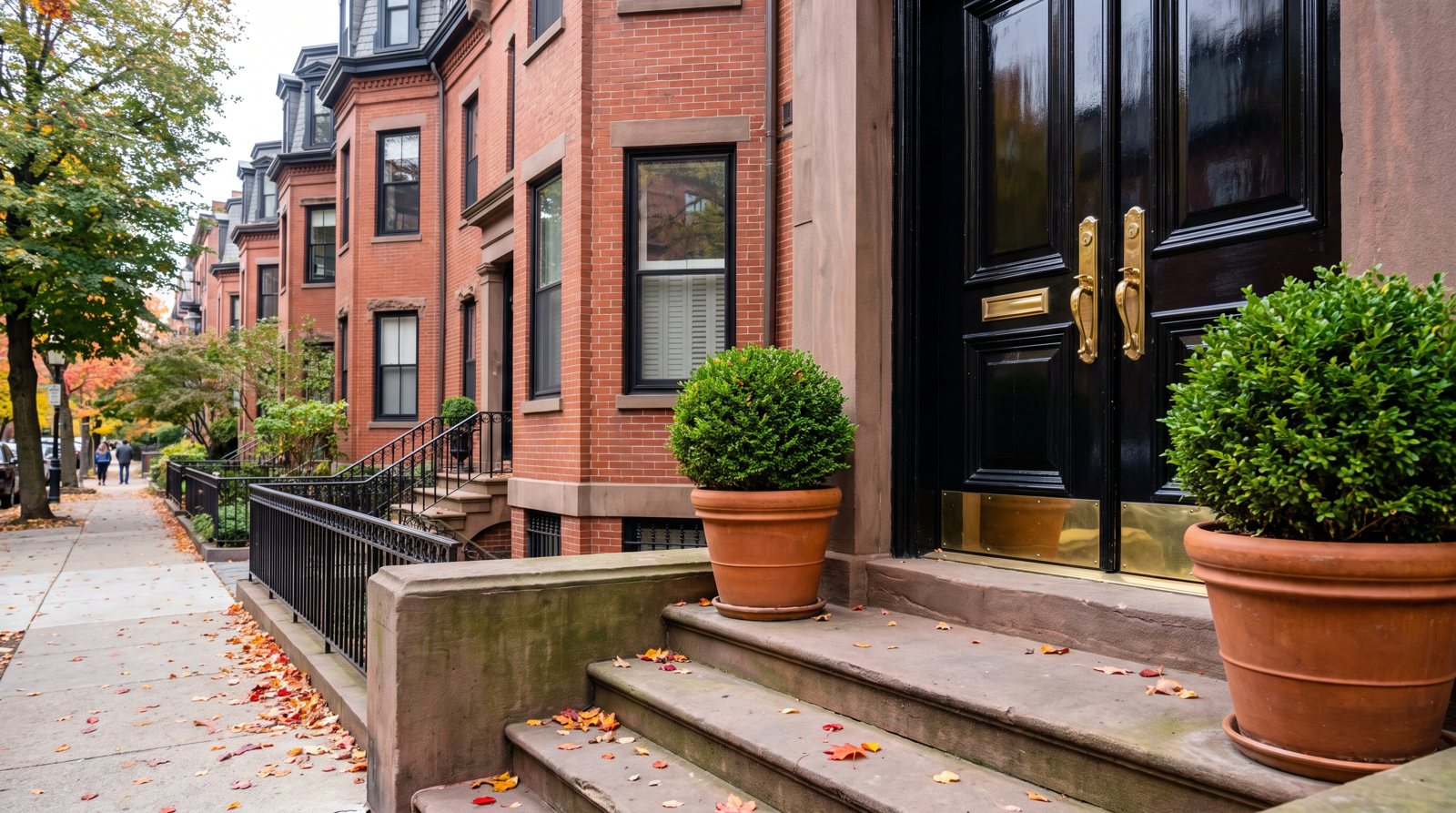
How to price a brownstone home in Back Bay
A Back Bay home is priced from recent sales of comparable homes, not from an online estimate. The two questions that matter most are which sales are truly comparable and what separates your home from them.
Comparable sales by street and floor
Start with closed sales on the same street, then the same block, then the same floor. Streets differ in width, lot depth and setting (Commonwealth lots are 124.5 feet deep, Marlborough lots 112 feet), and the differences between Back Bay's streets carry into price. Within a building, a garden level and a top floor with a deck are different products. The Back Bay agent we recommend can prepare a written valuation from recent sales on your block.
Condo or whole house
A condo's price carries the association with it: the monthly fee, the reserve balance and any planned special assessment. A whole house carries the entire building: facade, roof, any approved roof deck, and the foundation on wood piles. Zillow's August 2026 typical value in ZIP 02116 was $1,298,982 for condos and $1,818,983 for single-family homes, a gap of about $520,000 before any street or floor adjustment.
Zillow values as context
Zillow publishes no street or building values, so use its ZIP and neighborhood figures as background only. Its August 2026 typical home values:
| Area | Typical value | 12-month change |
|---|---|---|
| Back Bay neighborhood | $1,340,764 | -2.2% |
| ZIP 02116, all homes | $1,355,771 | +0.6% |
| ZIP 02116, condos | $1,298,982 | n/a |
| ZIP 02116, single-family | $1,818,983 | n/a |
| City of Boston | $774,723 | -1.4% |
| Boston metro | $733,574 | +2.1% |
The trend by area is on the Back Bay housing market page.
Preparing a Back Bay home for sale
Records gathered before listing keep a sale on schedule. Start these early.
The 6(d) certificate
Under M.G.L. c. 183A, section 6(d), the condo association issues a statement of any unpaid common charges and other sums assessed against the unit. It must furnish the statement within ten business days of a written request and payment of a reasonable fee, and once recorded it clears the unit of liens for other sums then unpaid. Lenders require it to close; the 6(d) certificate guide covers timing.
Lead paint notification and records
Before the buyer signs a purchase and sale agreement, Massachusetts law requires the seller to give the state lead notification, any letter of interim control or full compliance, and anything the seller knows about lead in the home. A seller who fails to comply faces liability for damages and a penalty of up to $1,000. Read the lead paint rules for sellers before you list.
Architectural Commission approvals and open violations
Collect the approvals for past exterior work: windows, masonry, roof decks and headhouses. The Back Bay Architectural Commission approves no application while outstanding violations exist on a property, and in a condo building the whole building is treated uniformly, so a violation can affect every unit. Check the building's record before buyers do; Commission rules for renovation explains what needed approval.
Building and condo documents
A buyer's attorney will ask for the master deed and amendments, the declaration of trust and bylaws, the unit deed and floor plans, the budget and reserve balance, recent minutes, and any planned special assessment or litigation. For a whole house, add any foundation or pile inspection reports and records of repairs.
Smoke and carbon monoxide certificate
State law requires a smoke detector certificate of compliance on the sale of a residential building built before 1975 with one to five units, and a carbon monoxide certificate on the sale of any residential unit. The Boston Fire Department needs at least 10 business days' notice and advises applying as soon as the purchase and sale agreement is signed.
When to sell: sale speed and pricing in Greater Boston
No neutral source measures sale speed for Back Bay alone, so the figures below describe wider areas and are labelled as such.
Boston metro sale speed
In the Boston metro, Zillow's median days to pending was 13 in August 2026, against 24 nationally. Its median sale-to-list ratio for the metro was 100.4% in July 2026, and 54.9% of metro homes sold above list price that month.
Greater Boston condo figures
In the Greater Boston Association of REALTORS territory, condos had a median of 47 cumulative days on market in August 2026 and sold for 97.7% of original list price, with 3.2 months of supply. These are regional MLS PIN figures, not Back Bay figures.
Seller costs in Massachusetts
Deed excise
The Suffolk County Registry of Deeds sets the effective deed excise at $2.28 per $500 of price (or fraction), which is $4.56 per $1,000. It is paid by a separate check to the Commonwealth of Massachusetts.
| Sale price | Deed excise |
|---|---|
| $1,298,982 (02116 typical condo) | $5,923.44 |
| $1,500,000 | $6,840.00 |
| $1,818,983 (02116 typical single-family) | $8,294.64 |
| $2,000,000 | $9,120.00 |
Attorney and recording fees
Sellers in Massachusetts usually hire a real estate attorney for the purchase and sale agreement and the deed; ask for a quote, since fees vary. Recording a mortgage discharge at the Suffolk Registry costs $105. The full list of closing costs for buyers and sellers is on its own page.
Broker commission
Commission is negotiable, and there is no standard rate. Agree it in writing in the listing agreement.
The proposed Boston transfer fee
Boston has asked the Legislature for a seller-paid fee of up to 2% on sales over $2 million, with the first $2 million exempt. It is a proposal, not law: the petition (H.5464) was referred to the Committee on Revenue on May 28, 2026.
Taxes on the gain when you sell
Most of the cost of selling is paid at closing, but the gain can also be taxed when you file your return. This is how the rules work, not tax advice.
The federal home sale exclusion
Under the IRS rules for selling a main home, you may exclude up to $250,000 of gain from income, or up to $500,000 on a joint return with your spouse. You must have owned the home for at least 24 months of the five years before the sale and lived in it as your residence for at least 24 months in that period; the two periods need not overlap. You generally cannot use the exclusion if you excluded the gain on another home sale in the two years before. A condo you rented out or used as a second home may not meet the use test.
Reporting the sale
If you receive Form 1099-S from the closing, you must report the sale even when the whole gain is excluded, and any gain above the exclusion is reported on Schedule D and Form 8949. Keep records of what you paid, the improvements you made and your selling costs, since IRS Publication 523 uses them to work out the gain.
Massachusetts income tax
Massachusetts taxes most personal income at a flat 5.00% and adds a 4% surtax on taxable income above $1,107,750 for tax year 2026. A large taxable gain on a Back Bay home can push a seller's income past that threshold in the year of sale, so ask a Massachusetts CPA to estimate both returns before you accept an offer.
How the sale proceeds
Offer
A Massachusetts sale usually starts with a signed written offer and a deposit. The lead notification must be given before the purchase and sale agreement is signed, and a buyer may take ten days, or longer by agreement, for a lead inspection.
Purchase and sale agreement
The agreement sets the price, deposit, financing contingency and closing date. Once it is signed, order the 6(d) certificate and book the Fire Department inspection so neither holds up closing.
Closing
At closing the deed is recorded, the deed excise is paid, the seller's mortgage is paid off and its discharge recorded, and a condo's 6(d) certificate is recorded. Ask your attorney how property tax and condo fees will be prorated. If you would like a second opinion before you set a price, ask for a walk-through of recent sales on your street.
Frequently asked questions
Are home prices dropping in Boston?
It depends on the area. Zillow's typical home value for the City of Boston fell 1.4% in the 12 months to August 2026, and the Back Bay neighborhood figure fell 2.2%, while ZIP 02116 rose 0.6% and the Boston metro rose 2.1%. Zillow publishes no street or building values, so recent sales on your block say more about your home.
How much does it cost to sell a house in Boston?
Expect the Suffolk County deed excise of $4.56 per $1,000 of price ($6,840 on a $1,500,000 sale), your attorney's fee, a $105 fee to record the mortgage discharge, the smoke and carbon monoxide certificate, a condo's 6(d) certificate fee and the broker commission you negotiate. Prorated property tax and condo fees are settled at closing.
How much do you pay the IRS when you sell a house?
Often nothing on a main home. IRS rules let you exclude up to $250,000 of gain, or $500,000 on a joint return, if you owned and lived in the home for at least 24 months of the five years before the sale. Gain above that is taxable, and Massachusetts taxes most income at 5.00%, plus a 4% surtax on 2026 taxable income above $1,107,750. Confirm with a CPA.
How do I find my Boston home value?
Start with recent closed sales of similar homes on your street and floor, adjusted for light, outdoor space, parking and condition. Zillow's typical values (in August 2026, $1,298,982 for a 02116 condo and $1,818,983 for a 02116 single-family home) are ZIP-level background only. A written valuation from a local agent or an appraisal gives a figure for your specific home.
Is selling your home by yourself a good idea?
You can legally sell without a broker in Massachusetts, but the same duties apply: the lead paint notification before the purchase and sale agreement, the smoke and carbon monoxide certificate, the 6(d) certificate for a condo and the deed excise at closing. You would still want a real estate attorney for the agreement and the deed. Commission is negotiable, so compare that cost with the work you would take on.
What devalues a house the most?
In Back Bay, problems a buyer cannot fix quickly weigh most. Open Architectural Commission violations block new approvals for the property, a thin condo reserve raises the risk of a special assessment, and missing lead paint records or unapproved roof decks raise questions late in a sale. Resolve or document these before listing rather than after an offer.
What not to do when selling your home?
Do not skip the state lead notification, which must come before the purchase and sale agreement; the penalty is up to $1,000 plus damages. Do not start exterior work without Architectural Commission approval, and do not wait until after the agreement to request the 6(d) certificate or book the Fire Department inspection, which needs at least 10 business days' notice.
Sources
- Zillow Research: Home Values (ZHVI), neighborhood, ZIP, city and metro data, August 2026
- Zillow Research: Median days to pending, metro data
- Zillow Research: Median sale-to-list ratio, metro data
- Zillow Research: Share of homes sold above list, metro data
- Massachusetts Association of REALTORS / ShowingTime Plus: Local Market Update, August 2026, GBAR territory
- Back Bay Houses: Back Bay Deed Restrictions
- malegislature.gov: M.G.L. c. 183A, Section 6
- Massachusetts Real Estate Law Blog: Massachusetts Condominium Buying Guide
- malegislature.gov: M.G.L. c. 111, Section 197A
- U.S. EPA: Real Estate Disclosures about Potential Lead Hazards
- City of Boston: Back Bay Architectural Commission, Guidelines for the Residential District
- City of Boston: Back Bay Architectural District
- Boston Fire Department, Fire Prevention: Smoke and carbon monoxide detector inspections
- Suffolk County Registry of Deeds: Excise tax calculator
- Suffolk County Registry of Deeds: Fees & forms of payment
- malegislature.gov: M.G.L. c. 64D, Section 1
- City of Boston: Mayor Wu signs transfer fee petition
- Massachusetts Legislature: Bill H.5464 (194th General Court)
- IRS: Topic no. 701, Sale of your home
- Massachusetts DOR: Massachusetts tax rates
- Massachusetts DOR: 4% surtax on taxable income