
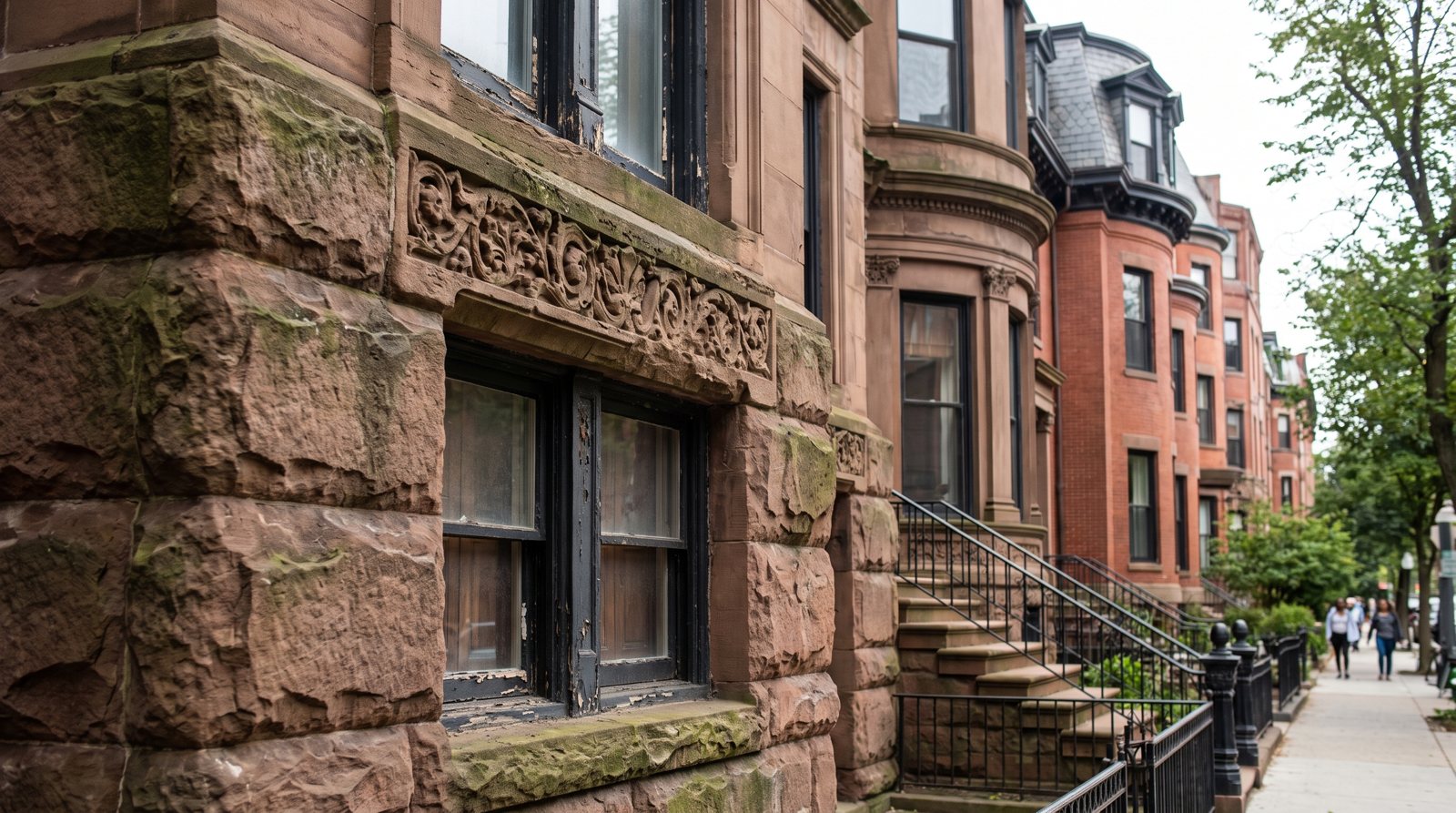
What is a brownstone?
Merriam-Webster defines brownstone two ways: as a reddish-brown sandstone used for building, and as a dwelling faced with that stone. The second meaning is the everyday one. Wikipedia adds that the term is now often applied loosely to rowhouses in general, including brick buildings that contain no brownstone at all.
This site uses the word in that everyday sense for Back Bay's 19th-century rowhouses, and says so where the difference matters, because many of them are red brick with brownstone trim.
What makes a home a brownstone?
Strictly, the facade: a house is a brownstone when its street front, or a large part of it, is faced in brownstone. In looser use, the form matters more than the stone: an attached masonry house of several stories, sharing side walls with its neighbors and set in a continuous row. Back Bay's original deeds required at least three stories and brick, stone or other non-combustible material, which produced exactly that form. The Back Bay Architectural Commission's guidelines describe the result as a continuous street facade with regular cornice lines and a repeating pattern of bays and oriel windows.
Stoops and raised entries
Many rowhouses are entered by a stoop, which Wikipedia defines as a small staircase ending in a platform at the entrance. The word comes from the Dutch stoep, and raising the entry kept a house apart from the waste of the street. A stoop is a feature of the rowhouse form, not of the stone, so brick rows have them too.
Victorian brownstones
The stone's popularity grew through the mid-1800s and peaked in the early 1890s, squarely in the Victorian era. The styles varied: the National Park Service calls the Gibson House in Back Bay an early example of the French Second Empire style, while the National Trust's architectural trust names Italianate as the predominant style of Boston's South End rows.
What is brownstone made of?
Sandstone colored by iron
Brownstone is sandstone; Wikipedia describes it as a brown Triassic-Jurassic sandstone. Its color comes from iron: in an oxygen-rich setting the iron rusts and coats each sand grain, in geologist David B. Williams's words, "like the skin of an apple." That iron oxide coating is what gives the stone its reddish-brown color.
The Portland, Connecticut quarries
The best-known Northeast source was the quarries at Portland, Connecticut, cut into the Early Jurassic Portland Formation of the Hartford Basin. A Columbia University field guide says the stone was used from the mid-1600s and that millions of tons were quarried in the second half of the 19th century. Connecticut Explored says the stone went out by schooner and faced row houses in Boston's Back Bay, Philadelphia, Brooklyn and Manhattan; the quarries became a National Historic Landmark in 2000.
Other sources
Wikipedia lists other major sources in New Jersey, at Hummelstown in Pennsylvania, and in Wisconsin's Apostle Islands.
Are brownstones only in New York?
No. New York's Brooklyn and Manhattan rows are the best known, but Wikipedia lists Boston's Back Bay alongside them as a place with prominent brownstone townhouses, and Connecticut Explored traces Portland stone to Philadelphia as well. In Boston the word is used for the rowhouses of Back Bay, the South End and Beacon Hill; Boston's brownstone neighborhoods compares the three.
Back Bay is a good example because its houses were built on new land under one plan. Filling of the tidal flats began in 1857, an 1856 plan fixed the street grid, and Back Bay Houses counts 1,156 buildings put up on the original lots, mostly as single-family houses.
Brownstone vs townhouse vs rowhouse
The three words describe different things: a brownstone is defined by its material, a townhouse by how it is used, and a rowhouse by its form. One building can be all three.
| Term | What it describes | Dictionary meaning (Merriam-Webster) |
|---|---|---|
| Brownstone | Material | A reddish-brown sandstone, or a dwelling faced with it |
| Townhouse | Use | A usually single-family house of two or three stories connected to a similar house by a common sidewall; also a city residence of someone whose chief residence is elsewhere |
| Rowhouse | Form | One of a series of houses connected by common sidewalls and forming a continuous group |
Brownstone
A brownstone is named for its facing stone. Strictly, a brick rowhouse is not a brownstone, though it often gets called one.
Townhouse
A townhouse is a house, usually single-family, attached to its neighbor. The dictionary's second sense, a city residence for someone whose main home is elsewhere, fits Back Bay's early history: Back Bay Houses says that before the 1890s its houses were largely winter residences.
Rowhouse
A rowhouse is one of a continuous group joined by shared side walls. The word says nothing about material or ownership, so a brick row, a brownstone row and a row divided into condos all qualify.
How the terms overlap in Back Bay
A Back Bay house is a rowhouse by form, a townhouse if it is still one household, and a brownstone if its front is the stone or, loosely, whatever its front is. Once divided into condominiums it is still a rowhouse, but you buy a unit rather than a townhouse; Back Bay townhouses that are still single-family covers whole-house purchases.
Why did builders stop using brownstone?
Weathering
Brownstone is layered, and water and salt get between the layers. Water expands about nine percent when it freezes and salt crystals grow, which breaks the face of the stone away, a failure called spalling. Connecticut Explored adds that fractures and spalling were often caused by poor seasoning, cutting or placement of the stone veneer.
Changing taste
Demand for brownstone peaked in the early 1890s and was largely over by the end of that decade, according to Williams, and quarrying at Portland ended in the 1920s. Back Bay shows the shift on its own streets: a City historic-districts official has described the early buildings as often brownstone and "quite French," later ones as drawing on London, and those of the 1890s as exploring colonial and federal styles and materials.
Can brownstones be built today?
A new house can still be given a brown stone front or a look-alike, but the classic supply is gone: quarrying at Portland ended in the 1920s. Wikipedia notes that "brownstone" also covers townhouses faced with a similar-looking material, and that many townhouses in Brooklyn's Boerum Hill are brick with concrete masonry cladding which resembles stone.
In Back Bay, new rowhouses almost never appear for a different reason. By 1900 almost all of the original lots had been built on, and the Commission's guidelines prohibit demolition of historic structures in the residential portion of the district. When old stone fails, any replacement material must approximate brownstone in composition, appearance and texture.
Caring for a brownstone in Back Bay
In Back Bay, the Back Bay Architectural Commission (created by Chapter 625 of the Acts of 1966) reviews all proposed exterior work. You file a Design Approval Application, receive a decision letter, and then apply for a building permit from Inspectional Services. Full rules for windows, roofs and decks are in renovating under the Back Bay Commission's rules.
Design approval before work
The Commission hears applications on the second Wednesday of each month, and an application must arrive at least two weeks before the hearing; incomplete ones are not heard. Ordinary maintenance means work with no change in materials, design, color or appearance, but the guidelines count masonry cleaning, repointing, repair and painting as exterior work.
Cleaning and repointing
Sandblasting, wire brushing and other abrasive cleaning are not allowed. New mortar must match the original, with a high sand and lime content.
Repairing or replacing stone
The guidelines say brownstone may need special treatment with particular materials and coatings, and each case is reviewed on its own. Any replacement material must approximate brownstone in composition, appearance and texture.
Violations and condo buildings
The Commission approves no application while outstanding violations exist on the property, and a condo or multi-owner building is considered as a whole and treated uniformly. Certificates of Appropriateness are valid for one year, so plan the work to start within that window.
Back Bay brownstone examples
The Gibson House
The Gibson House, now a museum on Beacon Street between Arlington and Berkeley, is the clearest public example. The National Park Service describes brownstone at the basement and first floor, red brick with brownstone trim on the upper floors, and a mansard roof: brownstone and brick together on one facade.
The first Back Bay houses
The first houses in the Back Bay went up on the north side of Beacon Street between Arlington and Berkeley, most in 1856 and two in 1857, on land filled before the main filling began. Building then moved west block by block until the last single-family house on an original lot was built in 1908.
Commonwealth Avenue
Commonwealth Avenue is a 200-foot boulevard whose houses face the Commonwealth Avenue Mall, and its lots are 124.5 feet deep, deeper than on neighboring streets. The 1890s apartment houses and apartment hotels clustered here and at the western end. For each street, see Back Bay's residential streets, and for the eras of construction, Back Bay's building history.
Pros and cons of owning a brownstone
These apply to the building type itself, whether you buy a whole house or one floor of it.
Pros
- Masonry walls. Back Bay's original deeds allowed only brick, stone or other non-combustible material, so none of the original houses are wood-framed.
- A protected street. Historic houses in the residential district cannot be demolished, and every exterior change goes through design review, so the block you buy into keeps its form.
- Proportions new buildings rarely copy. Carved stone, bays, oriels and cornices come with the house rather than as add-ons.
- A walkable setting. Walk Score rates Back Bay 97 for walking and 96 for transit, and says daily errands there do not require a car.
Cons
- Stone upkeep. Brownstone spalls as water and salt work into its layers, and repairs must use matching material and gentle cleaning methods, which takes specialist trades.
- Stairs. The deeds required at least three stories, so most homes involve stairs; confirm whether a converted building has an elevator.
- Foundations you cannot see. The houses stand on wood piles that stay sound only while groundwater covers them.
- Lead paint rules. Every original house predates 1978, so lead disclosure applies to each sale; the Massachusetts lead paint law explains what that means.
- Parking. A space cannot be assumed, and a 2024 Boston Globe report described single Back Bay spaces selling for $250,000 and $385,000.
Are brownstones more expensive?
No source compares the prices of brownstone-faced and brick rowhouses directly, so the answer comes from location. Zillow's typical home value in Back Bay's main ZIP, 02116, was $1,818,983 for single-family homes and $1,298,982 for condos in August 2026, against $774,723 for the City of Boston as a whole.
Within Back Bay, street, floor, light, outdoor space, parking and the condition of the masonry move a price more than the facade material alone. If you own one, valuing a brownstone you own explains how a price is built from nearby sales.
Frequently asked questions
What makes a home a brownstone?
Strictly, a facade of brownstone, the reddish-brown sandstone colored by iron. In everyday use, a brownstone is any 19th-century attached masonry rowhouse of several stories, brick or stone. In Boston's Back Bay, many so-called brownstones are red brick with brownstone trim, and some have brownstone only at the lower floors.
How many rooms does a brownstone have?
There is no standard number. A brownstone is defined by its facing stone or its rowhouse form, not by a floor plan, and Back Bay's original deeds set only a minimum of three stories. Many Back Bay houses have since been divided into condos, so check the floor plan and unit deed for the specific home.
Are brownstones only in NYC?
No. Brooklyn and Manhattan have the best-known rows, but Wikipedia lists Boston's Back Bay among places with prominent brownstone townhouses, and Connecticut Explored says Portland, Connecticut stone faced row houses in Back Bay and Philadelphia as well as New York. Other quarries in New Jersey, Pennsylvania and Wisconsin supplied other cities.
What's the difference between a brownstone and a townhouse?
A brownstone is named for its material, a facade of reddish-brown sandstone. A townhouse is named for its use: Merriam-Webster defines it as a usually single-family house of two or three stories joined to a similar house by a common sidewall. A single Back Bay house can be both, and once divided into condos it is no longer a townhouse.
Are brownstones more expensive?
No source isolates the stone's effect on price, so location does the work. In Back Bay's main ZIP, 02116, Zillow's typical value in August 2026 was $1,818,983 for single-family homes and $1,298,982 for condos, against $774,723 for the City of Boston. Street, floor and condition matter more than whether the facade is brownstone or brick.
Why did they stop building brownstones?
Brownstone weathers badly. Water and salt get into its layers, water expands about nine percent when it freezes, and the stone's face spalls off, especially when the stone was poorly seasoned or set. Taste also moved on: demand peaked in the early 1890s, Back Bay builders turned to colonial and federal models, and Portland quarrying ended in the 1920s.
What is a Victorian brownstone?
A brownstone rowhouse built during the Victorian decades, when the stone's popularity grew through the mid-1800s and peaked in the early 1890s. Styles varied: the National Park Service calls Back Bay's Gibson House an early example of the French Second Empire style, and Boston's South End rows are predominantly Italianate.
How much do brownstones cost in NYC?
We cover Boston, not New York, and track no New York sales. Wikipedia says New York City brownstones can cost several million dollars to purchase. For comparison, Zillow's typical single-family value in Back Bay's main ZIP, 02116, was $1,818,983 in August 2026, and its typical condo value $1,298,982. In both cities price depends on the block, the condition and whether you buy a whole house or one unit.
Sources
- Merriam-Webster: brownstone
- Merriam-Webster: town house
- Merriam-Webster: row house
- Wikipedia: Brownstone
- David B. Williams, Street Smart Naturalist: The Most Hideous Stone Ever Quarried
- Lamont-Doherty Earth Observatory field guide: The Portland Brownstone Quarries, Portland, Connecticut
- Connecticut Explored: The Quarry That Built Boston and New York City
- National Park Service: Gibson House, National Historic Landmark registration form
- Architectural Trust: City and State: Boston, Massachusetts
- Back Bay Houses: Overview: Development of the Back Bay
- Back Bay Houses: Back Bay Deed Restrictions
- Back Bay Houses: Back Bay Development 1855-1859
- Back Bay Houses: Back Bay Development 1890-1899
- Back Bay Houses: Back Bay Development 1900-1909
- Boston.com: From Landfill to 'Work of Art': Back Bay Architectural District (Feb 5, 2015)
- City of Boston: Back Bay Architectural District
- City of Boston: Back Bay Architectural Commission, Guidelines for the Residential District
- Friends of the Public Garden: The Mall
- Zillow Research: Home Values (ZHVI), neighborhood, ZIP, city and metro data, August 2026
- Wikipedia: Stoop (architecture)
- David B. Williams (geologywriter.com): The Most Hideous Stone Ever Quarried
- Walk Score: Living in Back Bay Boston
- Boston Groundwater Trust
- The Boston Globe (via Boston.com): $500,000 for a parking spot? Inside the world of exclusive parking in Boston (May 2024)
- U.S. EPA: Real Estate Disclosures about Potential Lead Hazards