
At a glance
| Walk Score | 97 (Walk Score, retrieved October 2026) |
|---|---|
| Zillow typical home value | $1,340,764, August 2026 |
| Rapid transit | Green Line: Arlington, Copley, Hynes; Orange Line: Back Bay |
| Commonwealth Avenue Mall | 32 acres, laid out by Arthur Gilman, 1856 |
| Police district | Boston Police District D-4 |
| Historic district | Back Bay Architectural District, 1966 |
Where is Back Bay in Boston?
Back Bay sits west of Boston Common and the Public Garden and east of the Back Bay Fens. The Charles River and the Esplanade run along its north edge, and Boylston Street, Copley Square and Back Bay station mark its southern side. Arlington Street is the first cross street on the east, and Charlesgate East is the last on the west.
The historic core is the Back Bay Architectural District, set up by the state in 1966. Its jurisdiction runs from Back Street (the alley behind the river side of Beacon Street) south to Boylston Street, and from Arlington Street west to Charlesgate East. Inside it, five long streets run east to west: Beacon Street, Marlborough Street, Commonwealth Avenue, Newbury Street and Boylston Street. The cross streets between them run in alphabetical order, Arlington to Hereford, which makes the grid easy to learn. The street-by-street guide to Back Bay covers what each one is like to live on.
Almost all of it is made land. The City of Boston describes the area as tidal flats used for mill operations, and landfilling in the mid-1800s produced over 450 acres of usable land by the 1880s. That is why the streets are straight, the blocks are even and the houses date from a narrow window of about fifty years; the story of the filling and the 1856 plan explains how it happened.
Pros of living in Back Bay
Daily errands on foot
Walk Score gives Back Bay a Walk Score of 97 and ranks it the 7th most walkable neighborhood in Boston. Its page states that daily errands do not require a car here. For comparison, Walk Score rates the City of Boston as a whole 83. Groceries, pharmacies, banks and the Central Library are within the grid, and the Public Garden is at the east end of every main street.
Transit on every side
Few Boston neighborhoods have this many stations inside or at their edges. Arlington and Copley are served by all four Green Line branches, Hynes Convention Center by three, and Back Bay station by the Orange Line, four Commuter Rail lines and Amtrak. Walk Score gives Back Bay a Transit Score of 96 and a Bike Score of 87.
Parks at both ends and through the middle
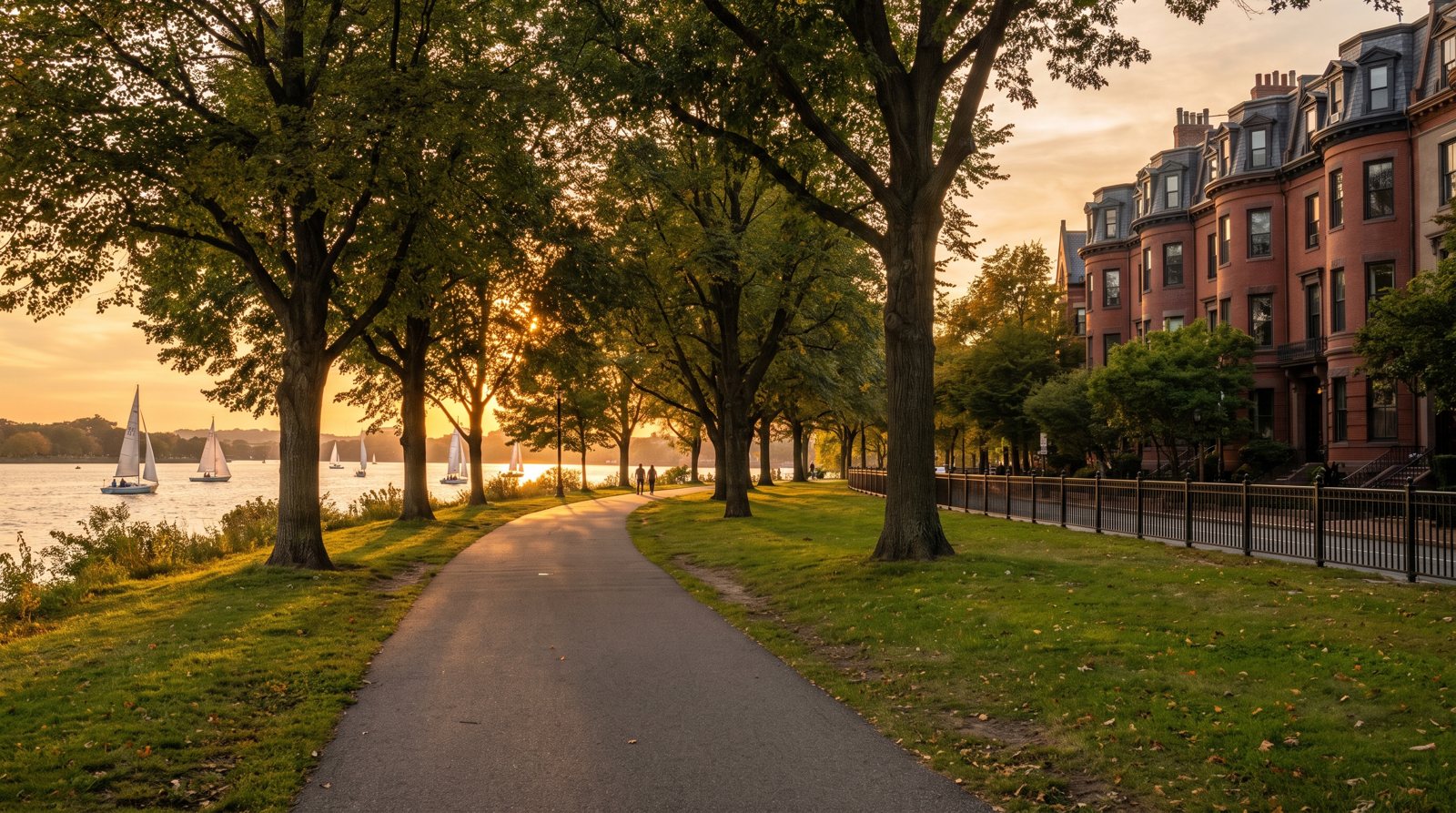
The Public Garden (established 1837) anchors the east end, the Commonwealth Avenue Mall carries a tree-lined walk the length of the neighborhood, and the Esplanade runs along the river behind Beacon Street. The Back Bay Fens, part of the Emerald Necklace, lies just past Charlesgate to the west.
A protected streetscape
The 19th-century deed restrictions set heights, setbacks and materials, and the Architectural Commission now reviews exterior changes. The result, in the Commission's own words, is a consistency of character, form and scale: a continuous street facade, regular cornice lines and repeating bays and oriel windows. Buyers know the block they buy on is unlikely to change much.
Homes with real history
Back Bay Houses counts 1,156 buildings built on the original lots of the residential district, mostly between the late 1850s and 1900. Many are now condominiums: floor-through units, duplexes and top-floor units inside the old houses. A smaller number remain whole single-family houses. The guide to Back Bay brownstone condos explains the unit types and what they cost to own.
Cons of living in Back Bay
Prices
Zillow's typical home value for the Back Bay neighborhood was $1,340,764 in August 2026, against $774,723 for the City of Boston. In ZIP 02116 the typical condo value was $1,298,982 and the typical single-family value $1,818,983. Most purchases here need a jumbo loan, and the FY2026 residential tax rate of $12.40 per $1,000 adds to the monthly cost (see how Boston property tax and the residential exemption work).
Parking
Most brownstones have no garage. City resident parking permits are free but valid only in the neighborhood where you live, and Boston issues no visitor permits. MBTA says Back Bay station has no parking. Deeded spaces in alleys and garages sell separately; a 2024 Boston Globe report described outdoor Back Bay spaces selling for $250,000 and $385,000, which are individual sales, not typical prices. The Back Bay parking guide covers permits, garages and deeded spaces.
Upkeep of older buildings
Every house here is well over a century old. Brownstone fronts spall when water and salt get into the stone, slate roofs and cornices need regular work, and the buildings stand on wood piles that must stay below groundwater. In a condo, those costs are shared through the monthly fee, the reserve fund and, when reserves fall short, special assessments. Ask the condo trust for its budget, reserves and any planned assessment before you make an offer. The rest of the monthly picture, from taxes to utilities, is in what it costs to live in Back Bay.
Architectural Commission review
All proposed exterior work in the district goes to the Back Bay Architectural Commission, including windows, doors, masonry, paint colors, roof decks and HVAC equipment. Replacement windows generally have to be wood double-hung sash, and roof decks must be minimally visible from any public way. The renovation and approvals guide sets out what needs a hearing and when.
Busy commercial blocks
Newbury Street's shops and restaurants, the Boylston Street retail corridor, Copley Square and the Prudential Center draw heavy foot traffic, deliveries and evening activity. The residential blocks of Beacon, Marlborough and Commonwealth sit a block or more away, so a home's distance from Newbury and Boylston makes a difference to how busy its street is.
Getting around Back Bay
Green Line stations
Arlington station (Arlington and Boylston Streets) and Copley station (Boylston and Dartmouth Streets) are served by all four Green Line branches, B, C, D and E, and MBTA marks both as wheelchair accessible. Hynes Convention Center station, at 100 Massachusetts Avenue, is served by the B, C and D branches. MBTA data lists Hynes as not wheelchair accessible, so check elevator status on mbta.com before relying on it. Kenmore station is just west of the neighborhood.
Back Bay station
Back Bay station, at 145 Dartmouth Street, serves the Orange Line and four Commuter Rail lines: Framingham/Worcester, Franklin/Foxboro, Needham and Providence/Stoughton. Amtrak stops there with the Acela, the Northeast Regional and the Lake Shore Limited. The station has elevators, escalators and high-level platforms, free Pedal and Park bike storage for registered CharlieCard holders, and no car parking. Massachusetts Avenue station on the Orange Line sits at the southern edge of the neighborhood.
Logan Express to the airport
Massport's Back Bay Logan Express bus costs $3 from Back Bay, and the return trip is free. It picks up at 800 Boylston Street (the Prudential Center's Boylston entrance) and at the Dartmouth Street entrance to Copley Place, runs every half hour from 5:00 AM to 9:00 PM outbound and 6:00 AM to 10:00 PM from Logan. Massport publishes no travel time, so check its page for fares and hours.
Bluebikes
Bluebikes bike-share stations in and around Back Bay include Dartmouth Street at Newbury Street, Clarendon Street at Newbury Street, Newbury Street at Hereford Street, Boylston Street at Berkeley Street and the Back Bay T stop. Station locations change, so check the Bluebikes app for the current map.
Walk Score's ratings, retrieved in October 2026, can change without notice; check its Back Bay page for current figures.
Parks and landmarks
Public Garden
Established in 1837, the Public Garden is, according to the City of Boston, the first public botanical garden in America. Its Swan Boats have been run by the Paget family for over 100 years. It faces Arlington Street, so the first block of every east-west street looks onto it.
Commonwealth Avenue Mall
The City describes the Mall's 32 acres as designed in the French boulevard style by Arthur Gilman in 1856 and built out between 1856 and 1888. It links the Public Garden to the Olmsted park system. The elms it was once known for were lost to Dutch elm disease, and it is now planted with sweetgum, green ash, maple, linden, zelkova, Japanese pagoda and elm. The Friends of the Public Garden, founded in 1970, cares for it with the Boston Parks Department. See the Commonwealth Avenue street guide for the homes that face it.
Charles River Esplanade
The Esplanade runs three miles along the Boston bank of the Charles, from the Museum of Science to the Boston University Bridge, with over five miles of paved paths and eight pedestrian bridges. The Esplanade Association, a nonprofit founded in 2001, works on it with the state Department of Conservation and Recreation.
Copley Square
The Boston Public Library's Central Library, at 700 Boylston Street, has been in Copley Square since 1895 in Charles Follen McKim's building. Trinity Church, by Henry Hobson Richardson, was built from 1872 to 1877 on newly filled land and was named a National Historic Landmark in 1971.
Back Bay Fens
West of Charlesgate, the Back Bay Fens was established in 1879 by Frederick Law Olmsted and is part of the Emerald Necklace. It holds the Kelleher Rose Garden and the Fenway Victory Gardens, which the City calls the nation's last remaining original World War II victory gardens.
Is Back Bay safe? What Boston Police data shows
Back Bay is policed by Boston Police District D-4, whose station is at 650 Harrison Avenue in the South End. BPD says D-4 covers four neighborhoods: the South End, Lower Roxbury, Back Bay and the Fenway. Its area also includes Copley Place, the Central Library, Boston Medical Center, the Museum of Fine Arts, Fenway Park, Boston University and Northeastern University. Any D-4 figure therefore describes a much larger area than Back Bay.
| Period | Incident reports logged in District D-4 |
|---|---|
| 2023 (calendar year) | 10,409 |
| 2024 (calendar year) | 11,319 |
| 2025 (calendar year) | 12,765 |
| January 1 to September 30, 2025 | 9,477 |
| January 1 to September 30, 2026 (preliminary) | 9,442 |
These counts come from the City's Analyze Boston dataset of BPD crime incident reports, queried on October 7, 2026. They count every incident report, one row per report, and that includes non-crime entries such as sick assists, lost property and towed vehicles. In 2025 the most common D-4 report types were shoplifting (1,559), investigate person (1,294) and sick assist (1,251). They are not FBI Part One crime counts, and BPD's own Part One statistics page showed reports only through August 2023 when checked. Recent months may still be revised.
To see reports near a specific address, use the crime incident data on Analyze Boston (data.boston.gov), which can be filtered by street, or contact District D-4 directly.
Schools and Boston Public Schools assignment
Boston Public Schools assigns students in kindergarten through grade 8 under a Home-Based plan that starts from the family's home address. Each family's list includes every school within one mile of home plus, as needed, nearby high-quality schools, and BPS says most families get 10 to 14 options. Seats are then assigned by an algorithm similar to a lottery, and BPS says it cannot guarantee a top choice. No home in Back Bay comes with a seat at a particular school.
BPS high schools serving grades 7-12 and 9-12 are citywide options open to all students. The three exam schools, Boston Latin Academy, Boston Latin School and the John D. O'Bryant School of Mathematics and Science, admit new students in grades 7 and 9 using a composite of grades and a MAP Growth test score.
To see which schools would be on the list for a specific address, use Great Starts, the City's school search and application tool at boston.explore.avela.org, or contact BPS Welcome Services.
Back Bay housing: units, owners and renters
The Boston Planning and Development Agency's neighborhood profile, based on the 2016-2020 American Community Survey, counts 10,111 occupied housing units in Back Bay, which is 82.5% of all housing units. Of the occupied units, 30.6% (3,095) are owner-occupied and 69.4% (7,016) are rented. Citywide, 35.3% of occupied units are owner-occupied.
Units are small on average: the same profile puts 59.6% of Back Bay units at studios or one-bedrooms, 26.0% at two bedrooms, 11.7% at three and 2.7% at four or more. Three- and four-bedroom homes, whether whole houses or large duplex condos, are the scarce end of the stock. For current values by ZIP and home type, see the Back Bay housing market report.
Buyer checklist for Back Bay
- Confirm the ZIP. Most of the residential district uses 02116; check the address with USPS (see which Back Bay ZIP codes cover what).
- Get the condo documents. Ask for the 6(d) certificate, budget, reserve balance, recent minutes and any planned special assessment (see the 6(d) certificate explainer).
- Check Architectural Commission history. Ask whether the building has open violations, and whether any roof deck or window work you are counting on was approved.
- Ask about piles and groundwater. Request any foundation or pile reports and look up the nearest Boston Groundwater Trust observation wells.
- Review lead paint records. Every brownstone predates 1978; ask for any inspection reports or letters of compliance (see the Massachusetts lead paint rules for buyers and sellers).
- Price the parking. Confirm in writing whether a space is deeded, assigned or leased, or get garage rates.
- Run the monthly cost. Add mortgage, the FY2026 tax bill, condo fee and insurance.
- Walk the block at night and on a weekend. Distance from Newbury, Boylston and the Hynes area changes street noise.
If you already own here and are weighing a move, start with recent sales for your building and street; the page on selling a Back Bay brownstone home sets out how that works.
Frequently asked questions
Is Back Bay a nice part of Boston?
Back Bay is a 19th-century rowhouse neighborhood protected as an architectural district since 1966, with the Public Garden, the 32-acre Commonwealth Avenue Mall and the Charles River Esplanade at its edges and center. Walk Score rates it 97. Its homes are among Boston's most expensive: Zillow's typical value was $1,340,764 in August 2026. Whether it suits you depends on budget, parking needs and tolerance for older-building upkeep.
Is Back Bay the richest neighborhood in Boston?
Measured by home values, Back Bay is at the top of the neighborhoods compared here. Zillow's typical home value in August 2026 was $1,340,764 for Back Bay, $1,105,539 for Beacon Hill, $1,080,575 for the South End and $774,723 for the City of Boston as a whole. Zillow values describe homes, not households, and change monthly.
What is Back Bay, Boston known for?
Back Bay is known for its Victorian rowhouses on land filled between 1857 and the 1880s, its straight street grid with cross streets in alphabetical order from Arlington to Hereford, and the Commonwealth Avenue Mall. Newbury Street's shops, Copley Square with Trinity Church and the Central Library, and the Charles River Esplanade are also in or beside it.
Why is it called Back Bay?
The neighborhood is named for the tidal bay it replaced. The area was a shallow bay and tide lands on the Charles River, cut off from the river by the Mill Dam, finished in 1821. Filling began in 1857 and reached the western end in the early 1880s, and the new streets kept the old name of the water.
Is Back Bay walkable?
Yes. Walk Score gives Back Bay a Walk Score of 97, a Transit Score of 96 and a Bike Score of 87, and ranks it the 7th most walkable neighborhood in Boston. Its page says daily errands do not require a car. Green Line stations at Arlington, Copley and Hynes and the Orange Line at Back Bay station cover most trips.
Is Back Bay safe?
This site gives Boston Police data rather than a verdict. Back Bay is in BPD District D-4, which also covers the South End, Lower Roxbury and the Fenway. Analyze Boston lists 12,765 incident reports in D-4 for 2025, including non-crime entries such as sick assists and towed vehicles. For a specific address, filter the data on data.boston.gov or contact District D-4.
Where is Back Bay in Boston?
Back Bay lies west of the Public Garden and Boston Common, between the Charles River on the north and Boylston Street, Copley Square and Back Bay station on the south. Its residential streets run from Arlington Street west to Charlesgate East, where the Back Bay Fens begins. Most addresses in the residential district use ZIP code 02116.
What ZIP code is Back Bay?
The main Back Bay ZIP code is 02116, used by addresses such as Back Bay station, Arlington station, the Central Library and the Public Garden. Some addresses at the southwestern edge, such as the Christian Science Plaza, use 02115, which is shared with the Fenway and Longwood areas, and the Prudential Center area uses 02199. ZIP and neighborhood lines do not match exactly, so confirm a property's ZIP with USPS.
What part of Boston is 02116?
02116 is the main ZIP code of Back Bay, used by official addresses from the Public Garden and Arlington station west through Copley Square and Back Bay station. The City of Boston's table of neighborhoods and ZIP codes lists 02116 under Back Bay/Beacon Hill, and like any ZIP it can reach past neighborhood lines, so check a specific address with USPS.
Which neighborhood is best to live in Boston?
It depends on the home you want and what you can spend. Among Boston's rowhouse neighborhoods, Zillow's typical home value in August 2026 was $1,340,764 in Back Bay, $1,105,539 in Beacon Hill and $1,080,575 in the South End, against $774,723 for the city. Back Bay offers a straight grid of 19th-century houses, four rapid transit stations and the river parks; compare actual homes, transit and monthly costs.
Is $60,000 enough to live in Boston?
MIT's Living Wage Calculator says a single adult with no children in Suffolk County needs $69,891 a year before taxes for basic needs, including $29,455 for housing, so $60,000 is about $9,900 short of that minimum budget. It would take lower housing costs than MIT assumes. Owning in Back Bay, where Zillow's typical value was $1,340,764 in August 2026, is far beyond it.
Sources
- Walk Score: Living in Back Bay Boston
- Walk Score: Living in Boston
- Zillow Research: Home Value Index, neighborhood data (August 2026)
- Zillow Research: Home Value Index, ZIP data (August 2026)
- City of Boston: Back Bay Architectural District
- City of Boston: Back Bay Architectural Commission, Guidelines for the Residential District (PDF)
- Back Bay Houses: Overview, Development of the Back Bay
- MBTA: Arlington station routes
- MBTA: Copley station routes
- MBTA: Hynes Convention Center station
- MBTA: Back Bay station
- Amtrak: Boston Back Bay Station (BBY)
- Massport: Logan Express Back Bay
- Bluebikes: station information feed
- City of Boston: Public Garden
- City of Boston: Commonwealth Avenue Mall
- City of Boston: Back Bay Fens
- Esplanade Association: Map and directions
- Esplanade Association: About
- Boston Public Library: BPL History
- Trinity Church Boston: History
- Boston Police Department: District D-4
- City of Boston (Analyze Boston): Crime Incident Reports (August 2015 to date)
- Boston Police Department: Crime Statistics
- Boston Public Schools: Student Assignment Policy
- Boston Public Schools: Exam Schools
- City of Boston: Great Starts (formerly Discover BPS)
- Boston Planning & Development Agency: Boston in Context: Neighborhoods (April 2022)
- City of Boston Parking Clerk: How to get a resident parking permit
- City of Boston Parking Clerk: Resident Parking Permit FAQs
- The Boston Globe (via Boston.com): $500,000 for a parking spot? Inside the world of exclusive parking in Boston (May 2024)
- David B. Williams: The Most Hideous Stone Ever Quarried
- City of Boston: Neighborhood boundaries and ZIP codes (PDF, 2023)
- MIT Living Wage Calculator: Suffolk County, Massachusetts (updated Feb 15, 2026)