
At a glance
| Typical single-family value, ZIP 02116 | $1,818,983 (Zillow, August 2026) |
|---|---|
| Typical single-family value, ZIP 02115 | $1,026,642 (Zillow, August 2026) |
| Buildings on the original lots | 1,156 (Back Bay Houses, residential district) |
| Last single-family house on an original lot | 1908 |
| First Boston condo conversion | Back Bay, November 1969 |
| Required materials in the original deeds | Brick, stone or other non-combustible material |
What does single-family mean in Back Bay?
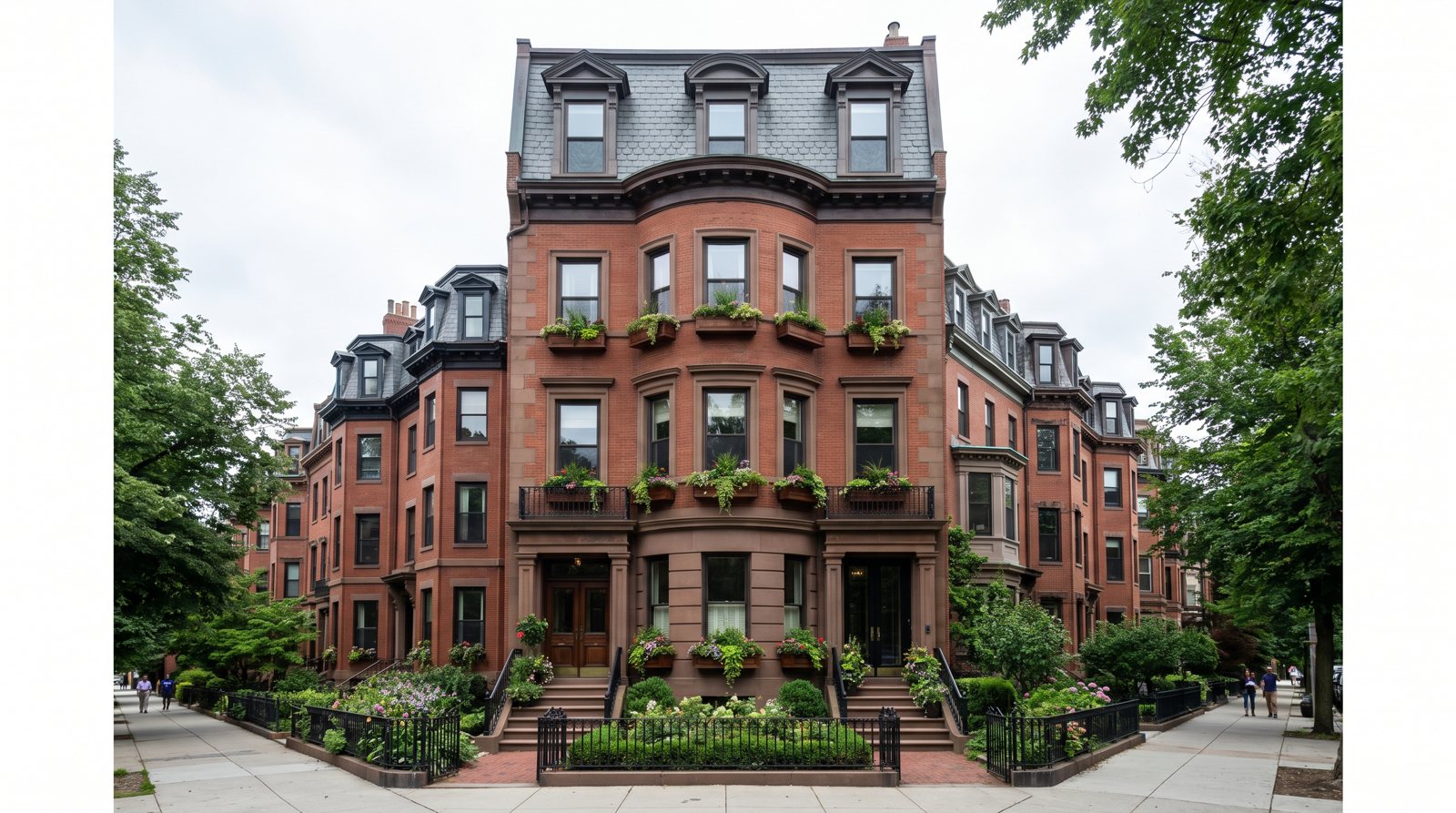
Here a single-family townhouse is the whole building on one lot: every floor from the garden level to the roof, the front areaway, the rear yard to the alley and, where one exists, the rear parking. You hold one deed and answer to no condo trust. Exterior work still goes through the Back Bay Architectural Commission, the same as for any building in the district.
How many whole houses remain is not published. Back Bay Houses records that some buildings have been converted back from apartments to single-family homes in recent decades, but it gives no count, and no official source opened for this page does either. Treat any figure you see quoted without a source with caution.
The deed restrictions that shaped these houses still show. Buildings had to be at least three stories high and built of brick, stone or other non-combustible material, so no Back Bay house was built of wood. Lots on Commonwealth Avenue are 124.5 feet deep, 12.5 feet deeper than the 112-foot lots on Marlborough, Newbury and the south side of Beacon.
Is a row house the same as a brownstone or a townhouse?
The three words overlap, and listings use them loosely. The dictionary meanings help.
Row house
Merriam-Webster defines a row house as one of a series of houses connected by common sidewalls and forming a continuous group. Almost every original Back Bay house fits: party walls on both sides, a continuous street facade and regular cornice lines, which the Commission's guidelines describe as the district's consistent character.
Townhouse
Merriam-Webster's town house is usually a single-family house of two or sometimes three stories connected to a similar house by a common sidewall, and also a city residence of someone whose main home is elsewhere. Before the 1890s, Back Bay Houses notes, these houses were largely winter residences, which fits the second sense.
Brownstone
Brownstone is a reddish-brown sandstone, and by extension a house faced with it. The word is now used loosely for row houses in general, including brick ones with no brownstone at all. Many Back Bay houses are red brick with brownstone trim; the Gibson House museum on Beacon Street has brownstone at the basement and first floor and brick above. See what makes a house a brownstone for the stone itself.
How Back Bay row houses were built and converted
Built as single-family houses, 1856 to 1908
The first houses went up on the north side of Beacon Street between Arlington and Berkeley in 1856 and 1857. Building followed the landfill west: 154 buildings in 1860 to 1864, 242 in 1870 to 1874, and 198 in 1880 to 1884 as land beyond Massachusetts Avenue was filled. The last single-family house on an originally vacant lot was built in 1908. The history of the Back Bay landfill covers each era.
Apartments and lodging houses after World War I
Most buildings were designed for one household, but after World War I many became apartments, lodging houses, dormitories, offices and institutions, a shift that intensified through the Depression and World War II. After 1910, new construction in the residential district focused on multiple dwellings.
Condominium conversion from 1969
Boston's first conversion of an existing residential building into condominiums happened in Back Bay in November 1969. Back Bay Houses calls condo conversion probably the single most important innovation that kept the original buildings in residential use and saved many from destruction. Most units you see for sale today come from these conversions; condos inside Back Bay brownstones explains the unit types.
Conversions back to whole houses
Some buildings have gone the other way and been restored to single-family use. If you are thinking of combining condo units back into one house, ask a Massachusetts real estate attorney how the master deed and the other unit owners would be involved, and remember that any exterior change still needs Commission approval.
What does a Back Bay townhouse cost to buy and own?
Price
| Area and home type | Typical value (Aug 2026) | 12-month change | 10-year change |
|---|---|---|---|
| ZIP 02116, single-family | $1,818,983 | -4.2% | +2.8% |
| ZIP 02116, condo | $1,298,982 | +3.4% | +24.9% |
| ZIP 02115, single-family | $1,026,642 | -10.1% | -13.5% |
| ZIP 02115, condo | $894,042 | +0.8% | +22.5% |
| City of Boston, all homes | $774,723 | -1.4% | +38.5% |
These are Zillow's August 2026 typical values by ZIP; Zillow publishes nothing by street or house. By its measure, whole-house values in 02116 have barely moved in ten years (+2.8%) while condo values there rose 24.9%, so the two have moved apart. A whole house on a wide Commonwealth Avenue lot and one on a narrower side-street lot can sit far apart, so comparable sales on the block decide value. The guide to Back Bay streets compares them.
Property tax
For a house assessed at $1,818,983, Boston's FY2026 residential rate of $12.40 per $1,000 gives about $22,555.39 a year without the residential exemption. An owner-occupant who qualifies has $351,108 of value exempted, bringing the bill to about $18,201.65, a saving of $4,353.74. The Community Preservation Act adds a 1% surcharge calculated after a $100,000 deduction. FY2027 rates are set in December 2026; the Boston tax bill guide has the deadlines.
Financing
FHFA's 2026 conforming limit for one unit in Suffolk County is $962,550, so a house at the 02116 typical value almost always needs a jumbo loan: 20% down still leaves about $1,455,186 to borrow. Freddie Mac's 30-year fixed average was 7.28% in the week of October 1, 2026. At that rate, principal and interest on $1,455,186 come to about $9,956.56 a month; add about $1,516.80 a month of FY2026 tax with the exemption and the total is about $11,473 before insurance, utilities and upkeep. Try the jumbo payment calculator with your own numbers.
What to check before buying a whole house
Back Bay Architectural Commission approvals
All proposed exterior work in the district needs Design Approval before it starts, including windows, masonry, paint colors, roof decks and HVAC, and alterations not visible from the street still fall under the Commission. No application is approved while violations are outstanding, and Certificates of Appropriateness last one year. Ask the seller for past approvals and read permits and approvals for brownstone work before you plan changes.
Groundwater and wood piles
Back Bay houses stand on wood piles driven through the fill. The Boston Groundwater Trust explains that piles stay sound while groundwater stays above their tops and decay when it falls. Look up nearby observation wells on the Trust's map, and ask for any pile or underpinning reports. Building Inspection Reports from 1879 to 1903 at the Boston Public Library can show a building's pile cutoff elevation.
Lead paint
Every original house predates 1978, so the state lead notice and the federal disclosure apply to the sale. Read the Massachusetts lead law for buyers before you sign a purchase and sale agreement.
Rear lot, alley and parking
The original deeds required a 16-foot rear passageway behind the lots, kept open by the abutters. Whether a house has usable rear parking depends on its lot and deed, so check the deed and plot plan; parking options for Back Bay owners covers permits and deeded spaces.
Pros and cons of owning a whole townhouse
Pros
- Control of the whole building: no trust votes, no shared budget and no special assessments set by others.
- The full original plan, front to rear yard, on a lot of 112 or 124.5 feet deep.
- One owner decides on long-term work such as masonry, roof and foundations.
Cons
- You carry every repair alone, from the roof to the piles.
- A higher price and tax bill: Zillow's 02116 single-family value is about $520,000 above the condo value.
- Exterior work needs Commission approval, and demolition of historic structures is prohibited in the residential district.
If you own a whole house and are weighing a sale, read how pricing and selling a townhouse works. Recent whole-house sales on your street are the best guide, and our recommended brownstone agent can pull them for you.
Frequently asked questions
Is a row house the same as a brownstone?
Not exactly. A row house is any house in a series joined by common sidewalls. A brownstone is, strictly, a house faced with brown sandstone, though the word is now used loosely for row houses in general. Many Back Bay row houses are red brick with brownstone trim or brownstone lower floors, so every Back Bay brownstone is a row house but not every row house has brownstone.
What cities are known for row houses?
Boston's Back Bay, Brooklyn and Manhattan are often named for brownstone row houses, and Connecticut Explored notes that brownstone fronts in Back Bay, Philadelphia, Brooklyn and Manhattan came from the Portland, Connecticut quarries. In Boston, the South End is described as the largest intact Victorian row-house district in the country, built from about 1850 to 1880.
How much is a single-family townhouse in Back Bay?
Zillow's typical single-family value in ZIP 02116, Back Bay's main ZIP, was $1,818,983 in August 2026, against $1,298,982 for a typical 02116 condo. In 02115 the single-family figure was $1,026,642. Zillow does not publish values by street or house, so recent sales of comparable whole houses on the same block are the real guide.
How many single-family homes are left in Back Bay?
No source we found publishes a count. Back Bay Houses records 1,156 buildings constructed on the original lots of the residential district, most of them as single-family houses, and says many became apartments after World War I and condominiums from 1969. It notes that some have been converted back to single-family homes but gives no number.
What is the richest neighborhood in Boston?
By home values, Back Bay ranks near the top. Zillow's typical value for the Back Bay neighborhood was $1,340,764 in August 2026, compared with $1,105,539 for Beacon Hill, $1,080,575 for the South End and $774,723 for Boston overall. Single-family homes in ZIP 02116 were typically $1,818,983.
Is $60,000 enough to live in Boston?
MIT's Living Wage Calculator puts the living wage for one adult with no children in Suffolk County at $33.60 an hour, about $69,900 a year at full-time hours. A Back Bay house costs far more to own: the FY2026 property tax alone on a house assessed at the 02116 typical value is about $18,201.65 a year with the residential exemption.
How much is property tax on a Back Bay townhouse?
Boston's FY2026 residential rate is $12.40 per $1,000 of assessed value. On a $1,818,983 assessment that is about $22,555.39 a year, or about $18,201.65 for an owner-occupant with the $351,108 residential exemption, plus the 1% Community Preservation Act surcharge. FY2027 rates are set in December 2026.
Sources
- Zillow Home Value Index (ZHVI), August 2026, via tools/data/backbay.json
- Back Bay Houses: Back Bay Development, 1910-2015
- Back Bay Houses: Frequently asked (or should be asked) questions
- Back Bay Houses: Overview: Development of the Back Bay
- Back Bay Houses: Back Bay Deed Restrictions
- Back Bay Houses: Back Bay Development 1855-1859
- Back Bay Houses: Back Bay Development 1860-1864
- Back Bay Houses: Back Bay Development 1870-1874
- Back Bay Houses: Back Bay Development 1880-1884
- Back Bay Houses: Back Bay Development 1900-1909
- Merriam-Webster: row house
- Merriam-Webster: town house
- Merriam-Webster: brownstone
- Wikipedia: Brownstone
- Wikipedia: South End, Boston
- Connecticut Explored: The Quarry That Built Boston and New York City
- National Park Service: Gibson House, National Historic Landmark registration form
- City of Boston: Back Bay Architectural District
- City of Boston: Back Bay Architectural Commission, Guidelines for the Residential District (PDF)
- Boston Groundwater Trust: Home
- Boston Groundwater Trust: Groundwater & Building Foundation Data
- City of Boston Assessing: How we tax your property
- City of Boston Assessing: Residential exemption
- City of Boston Assessing: Community Preservation Act
- FHFA: Conforming loan limits for 2026, full county list
- Freddie Mac: Primary Mortgage Market Survey
- MIT Living Wage Calculator: Suffolk County, Massachusetts