
At a glance
| Resident permit cost | Free (City of Boston) |
|---|---|
| Visitor permits | Not issued in Boston |
| Boston Common Garage capacity | 1,350 vehicles |
| Boston Common Garage monthly, 24/7 | $420 (posted rate at time of writing) |
| Back Bay alley space sale reported in 2024 | $250,000 (Boston Globe) |
Is there free parking in Back Bay?
For visitors, mainly on Sundays. The City's Parking Clerk says metered spaces are free on Sundays and City holidays, though other posted rules still apply. Boston's resident permits are free, but they are only for residents, and the City states that it does not issue visitor parking permits. Read the posted signs on each block before you leave a car. For a short stay on a weekday, a garage is the predictable choice.
Garage rates for a short stay
Boston Common Garage, beneath Boston Common just past the Public Garden, posted weekday rates of $14 for up to an hour, $20 for one to two hours, $26 for two to three hours, $30 for three to ten hours and $38 for ten to 24 hours. Rates change; check the operator's page before you go.
The rest of this page is written for owners and buyers, where parking is a question of permits, contracts and deeds.
Resident parking permits
A resident permit lets you park in the resident spaces of your own neighborhood. A permit lets you use resident spaces; it does not reserve a particular one.
Who qualifies
The car must be registered and principally garaged in your name at your current Boston address. Leased vehicles may qualify in some cases, for example when the lessee shares the same last name, but must be insured in Boston, and company vehicles may be eligible. Temporary permits are issued for Massachusetts temporary plates and rental vehicles, not for out-of-state plates.
How to apply
Apply online through the City's Parking Clerk; the permit arrives about 10 business days after approval. You can also apply in person at City Hall, 1 City Hall Square, Room 224, weekdays from 8:30 a.m. to 4:30 p.m. You need one proof of residency, such as a utility or cable bill, bank statement, mortgage statement, water and sewer bill, or signed lease. The sticker goes in the rear window on the passenger side.
Rules that catch new owners
- Permits are valid only in the neighborhood where you live; move and the old permit is no longer valid.
- There are no visitor permits, so guests and contractors need a garage or meter.
- All outstanding parking tickets must be paid in full before you apply or renew.
- Permits no longer carry printed expiration dates and renew automatically, but the City audits holders neighborhood by neighborhood on roughly a two-year cycle.
Street parking rules: meters, street cleaning and snow
Owners with a resident permit still live with the City's street rules, and so do their guests. These are the ones that cost Back Bay owners money.
Meter rates and hours
The City of Boston Parking Clerk lists Back Bay meters at $3.75 an hour, against $2.50 in Fenway and Kenmore and $2 an hour in other metered areas, including Beacon Hill and the South End. Meters on the south side of Boylston Street between Arlington and Clarendon Streets charge $1.00 for 15 minutes with a 15-minute limit, and some Back Bay meters have a 30-minute maximum. Most meters run Monday through Saturday, 8 a.m. to 8 p.m. The City's rate table is dated July 2019, so check the meter itself.
How to pay at a meter
Boston meters take quarters, credit and debit cards, or payment through the ParkBoston app; single-space meters accept Discover, MasterCard and Visa. You must be back before the paid time runs out.
When street parking is free
Metered spaces are free on Sundays and City holidays, but resident-only spaces, street cleaning, tow zones and other posted restrictions still apply. Resident permit parking is free only for permit holders in their own neighborhood.
Street cleaning
The City's daytime street cleaning runs from April 1 to November 30 in most neighborhoods, and night sweeping runs year round. Cars left on a street during its posted cleaning time are ticketed and can be towed by the City's contractors; the City lists the tow at $132 plus $35 a day in storage and a fuel surcharge. Look up your street's schedule at notify.boston.gov and sign up for reminders there.
Snow emergencies and space savers
During a declared snow emergency, a car parked on a posted snow emergency artery is ticketed and towed. The City offers discounted parking for residents at some lots and garages during snow emergencies; its list names the participating sites. Space savers may be used only during a declared snow emergency and must come out 48 hours after it ends, and the City bans them in the South End and Bay Village. Sign up for AlertBoston to hear when an emergency is declared.
Deeded, assigned and alley spaces
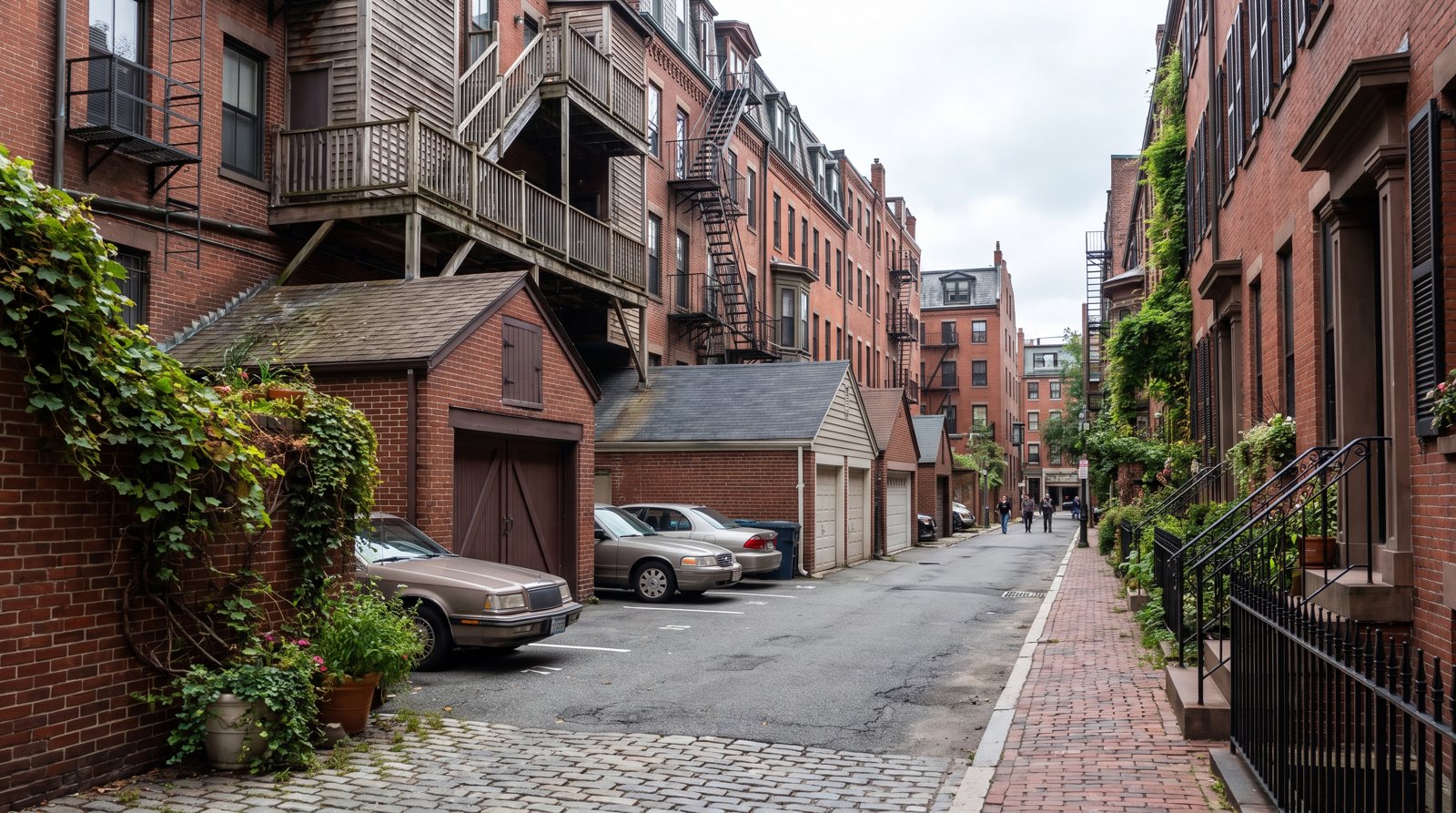
The original deed restrictions required a 16-foot rear passageway behind the lots, and a City preservation official has explained that the alleys kept delivery wagons off the main streets. Outdoor alley spaces, like those in the Globe report below, are one form of private parking today. How a space is held decides what you are buying.
Deeded, limited common area or leased
A deeded space is real estate conveyed by deed, separately or with a unit. In a condominium, a space may instead be a limited common area assigned to one unit in the master deed; under M.G.L. c. 183A s. 6(a)(ii) the association may charge the cost of maintaining, repairing or replacing it solely to that unit's owner. A leased or licensed space is a contract that can end. Get the arrangement in writing from the deed or master deed before you rely on it.
What spaces have sold for
A May 2024 Boston Globe report gives a sense of the extremes. It said an outdoor alley spot in Back Bay sold for $250,000 the previous year and a nearby spot for $385,000, and an outdoor parallel space was listed at $350,000. It also reported a Back Bay couple received a $750,000 offer for a space in 2022, and quoted a broker estimating that a Back Bay spot worth about $275,000 seven or eight years earlier now commands about $350,000. These are news anecdotes, not typical values; an offer is not a sale.
Taxes and fees on a space
The same report described deeded garage spaces in a Beacon Hill garage that sell privately like condominiums, with owners paying association fees and property taxes, at recent prices around $500,000 each. If you buy a deeded space, ask how it is assessed and what fees attach to it.
Monthly garage parking
Without a deeded space, the alternative is a monthly garage contract.
Boston Common Garage monthly rates
Boston Common Garage, at Zero Charles Street, holds 1,350 vehicles and is operated by Propark for the Massachusetts Convention Center Authority. Its posted monthly rates at the time of writing:
| Monthly plan | Posted rate | Per year |
|---|---|---|
| Reserved (limited availability) | $580 | $6,960 |
| 24/7 | $420 | $5,040 |
| Weekday only | $395 | $4,740 |
| Nights and weekends | $175 | $2,100 |
Comparing other garages
Other garages set their own prices and waiting lists. Check current monthly rates directly with each garage, and add the yearly figure to your budget alongside the condo fee and tax bill. Distance matters too: from the western blocks near Charlesgate the Common is a long walk, so compare garages closer to your street.
What a parking space means for a condo's value
No public source publishes how much a deeded space adds to a Back Bay home's price, and Zillow's values do not separate units with parking from units without. What the Globe figures do show is that a space can trade as an asset in its own right, at a price that would be a meaningful share of a unit at Zillow's typical 02116 condo value of $1,298,982 (August 2026).
When you price a home with parking, compare sales of similar units with and without a space, and check whether the space can be sold separately or only with the unit. A garage contract at $5,040 a year is the cost you avoid. For the rest of the buying checklist, see what to know about Back Bay condos; if you own a unit with a space, pricing a home with parking for sale starts with those comparisons. Lot depth also differs by street, from 124.5 feet on Commonwealth Avenue to 112 feet on Marlborough Street and the south side of Beacon Street, which shapes how much rear ground a building has; the street-by-street overview compares them.
What to check in the deed or master deed
- How the space is held. Deeded, limited common area, or leased. Read the language, not the listing.
- Exact location. The plan or description should identify the space; confirm it matches what you were shown.
- Transfer rules. Whether the space can be sold or leased apart from the unit, and to whom.
- Costs. Any separate tax bill, association fee, or repair charge to the unit under c. 183A s. 6(a)(ii).
- Condo finances. The 6(d) certificate and trust budget should show no unpaid charges tied to the space.
- Exterior changes. Paving or altering a rear lot can trigger Architectural Commission review and Article 32 groundwater rules.
If you are weighing a unit with parking, the agent we recommend for Back Bay can check the deed language and recent sales for you.
Frequently asked questions
Is there any free parking in Back Bay?
Metered spaces in Boston are free on Sundays and City holidays, though other posted rules still apply. On other days free on-street parking is essentially for residents: Boston's resident permits cost nothing but are valid only in the holder's own neighborhood, and the City does not issue visitor permits. Back Bay meters are listed at $3.75 an hour, Monday to Saturday, 8 a.m. to 8 p.m.
Where can I park in Back Bay?
You can use metered spaces on the streets (listed at $3.75 an hour, free on Sundays and City holidays), public garages such as Boston Common Garage beneath the Common, or resident spaces if your car carries a Back Bay resident permit. Owners can also buy or lease a private space; deeded alley spaces have sold for $250,000 and more, according to a 2024 Boston Globe report.
How do you pay for street parking in Boston?
Boston meters accept quarters, credit and debit cards, and the ParkBoston app, according to the City's Parking Clerk; single-space meters take Discover, MasterCard and Visa. Most meters run Monday through Saturday, 8 a.m. to 8 p.m., and you must return before your paid time runs out. Some Back Bay meters have a 30-minute maximum.
How much is parking in Back Bay, Boston?
Back Bay street meters are listed by the City at $3.75 an hour. For a short stay, Boston Common Garage posted weekday rates from $14 for up to an hour to $38 for ten to 24 hours, and monthly contracts from $175 for nights and weekends to $580 reserved. A deeded space is far more: a 2024 Boston Globe report described Back Bay alley spots selling for $250,000 and $385,000.
Where is the cheapest place to park in Back Bay?
A street meter on a Sunday or City holiday costs nothing, and resident permit spaces are free for Back Bay residents with a permit. On other days a meter at $3.75 an hour is usually cheaper than a garage for a short stop, within its time limit. For regular parking, Boston Common Garage's posted nights-and-weekends contract, at $175 a month, was its lowest monthly rate.
How much is Back Bay garage parking per month?
Boston Common Garage, a 1,350-space garage beneath Boston Common, posted monthly rates of $580 reserved, $420 for 24/7 access, $395 weekdays only and $175 for nights and weekends at the time of writing. That is $2,100 to $6,960 a year. Rates change, so confirm with the garage.
What is the most expensive parking spot in Boston?
No official record ranks them, but a May 2024 Boston Globe report described deeded spaces in a Beacon Hill garage selling for around $500,000 each, and a Back Bay couple who received a $750,000 offer for a space in 2022. An offer is not a sale, and these are news anecdotes rather than typical prices.
How do I get a Boston resident parking permit?
Apply online through the City of Boston Parking Clerk or in person at City Hall, Room 224. Your car must be registered and principally garaged in your name at your Boston address, and you need one proof of residency, such as a utility bill or mortgage statement. All parking tickets must be paid first. The permit is free and arrives about 10 business days after approval.
Does Boston have visitor parking permits?
No. The City of Boston Parking Clerk states that Boston does not issue visitor parking permits. Guests, contractors and movers need a garage, a metered space or an off-street space you control. Resident permits are valid only in the holder's own neighborhood.
Does a deeded parking space pay property tax?
It can. The 2024 Boston Globe report on parking described deeded garage spaces on Beacon Hill whose owners pay association fees and property taxes, much like condominium units. Ask how a specific space is assessed, whether it has its own tax bill, and what fees attach to it before you buy.
Sources
- City of Boston Parking Clerk: How to get a resident parking permit
- City of Boston Parking Clerk: Resident Parking Permits
- City of Boston Parking Clerk: Resident Parking Permit FAQs
- Massachusetts Convention Center Authority: Boston Common Garage
- The Boston Globe (via Boston.com): $500,000 for a parking spot? Inside the world of exclusive parking in Boston (May 2024)
- malegislature.gov: M.G.L. c. 183A, Section 6
- Back Bay Houses: Back Bay Deed Restrictions
- Boston.com: From Landfill to 'Work of Art': Back Bay Architectural District (Feb 5, 2015)
- Boston Groundwater Trust: Article 32, Groundwater Conservation Overlay District (GCOD)
- Zillow Home Value Index (ZHVI), August 2026, via tools/data/backbay.json
- City of Boston Parking Clerk: How do parking meters work?
- City of Boston: Street cleaning in Boston
- City of Boston: Managing winter and snow