
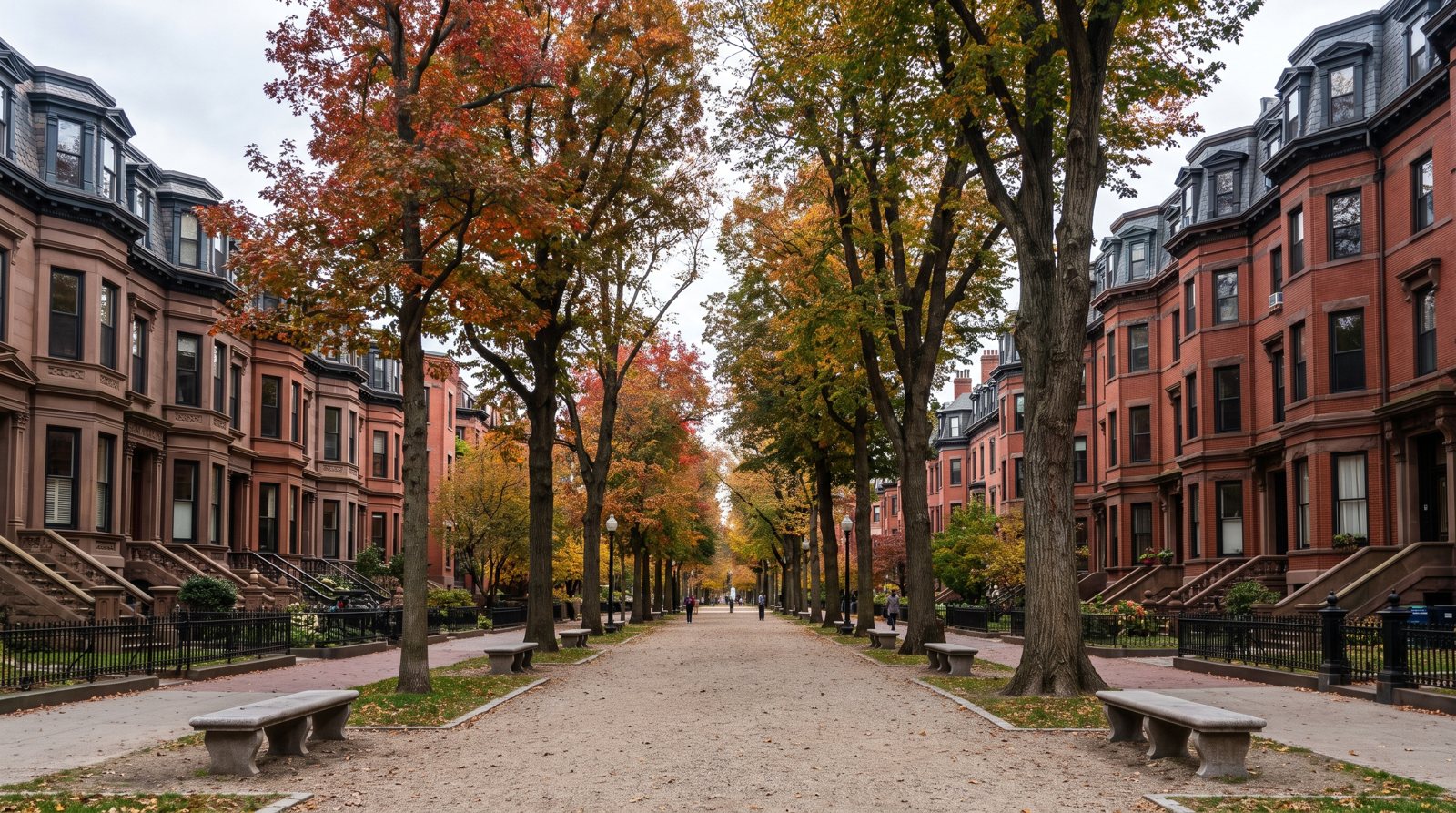
At a glance
| Runs | Arlington Street (Public Garden) west to Charlesgate East, 9 blocks |
|---|---|
| Width | 200 feet, with a 100-foot central Mall |
| Lot depth | 124.5 feet |
| Built | Mostly 1860s to 1900s, east to west; west of Massachusetts Avenue from the early 1880s |
| The Mall | 32 acres, designed by Arthur Gilman in 1856 |
| Historic review | Back Bay Architectural Commission (district created 1966) |
What is Commonwealth Avenue like?
Commonwealth Avenue is the Back Bay's widest street by a large margin. The 1856 plan called for 120 feet, and the avenue was widened to 200 feet, with two roadways running either side of a central Mall 100 feet wide. Beacon Street was planned at 70 feet and Marlborough and Newbury at 60, so a house here faces across far more open space than anywhere else in the grid.
The Mall is a 32-acre park that Arthur Gilman designed in the French boulevard style in 1856. The City calls it the green link between the Public Garden and Frederick Law Olmsted's park system, and the National Park Service lists it as an Olmsted-designed landscape and "a strong link in the Emerald Necklace." It was first planted with American elms; after losses to Dutch elm disease it now holds sweetgum, green ash, maple, linden, zelkova, Japanese pagoda and elm. Nine sculptures have been added since William Rimmer's Alexander Hamilton of 1865, among them the Boston Women's Memorial and the Vendome Firefighters' Memorial. The Friends of the Public Garden, founded in 1970, care for it with the Boston Parks Department.
The avenue was residential by design. The Commonwealth's deed restrictions barred mercantile uses on Commonwealth Avenue specifically, on top of the stable and manufacturing bans that applied across the district, and set a 20-foot front yard. The full story of the filling and the original plan is on our history of Back Bay's landfill and street plan.
Commonwealth Avenue homes and prices
Zillow does not publish values for a single street, so the closest neutral figures are for ZIP 02116, Back Bay's main ZIP code. In August 2026 Zillow's typical home value for 02116 was $1,355,771 for all homes (up 0.6% in a year), $1,298,982 for condos and $1,818,983 for single-family homes. Treat these as ZIP-level reference points: a Mall-facing parlor floor and a rear garden unit on the same block can sit far apart.
Condominiums in converted houses
Most Back Bay buildings went up as single-family houses, and after World War I many became lodging houses, apartments, dormitories or offices. Condominium conversion, which in Boston began in the Back Bay in November 1969, turned many of them back into owner-occupied homes. On the avenue that usually means a handful of units stacked by floor in one house, governed by a small trust. At the 02116 condo figure of $1,298,982, the loan would exceed the 2026 conforming limit for Suffolk County ($962,550) unless you put down more than about 26%, so jumbo financing in Massachusetts is the usual route. For unit types and condo documents, see Back Bay brownstone condos.
Whole single-family houses
A smaller number of houses remain, or have been converted back to, single-family use; Back Bay Houses notes such reconversions but gives no count. These are the deepest houses in the residential grid: Commonwealth lots run 124.5 feet, twelve and a half feet deeper than lots on Marlborough, Newbury and the south side of Beacon. Zillow's 02116 single-family figure of $1,818,983 is a floor, not a guide, for a full house on the Mall. Our guide to Back Bay townhouses covers what single-family means here.
Apartment houses from the 1890s on
The 1890s brought large apartment houses and apartment hotels to the Back Bay, mostly on Commonwealth Avenue and at the western end; 89 buildings went up from 1890 to 1899, and after 1910 almost all new construction was multiple dwellings. These buildings hold more units than a converted house, so the condo budget, reserve fund and any planned assessment matter as much as the unit itself.
Commonwealth Avenue block by block
Back Bay Houses indexes the avenue in nine blocks from Arlington Street to Charlesgate East. House numbers below are approximate ranges from that index; the Mall runs the full length.
Arlington to Berkeley (about 1 to 48)
The first block opens onto the Public Garden, established in 1837 and the first public botanical garden in America. Arlington Street here is 80 feet wide, laid out in front of the Garden under the 1856 agreement. Arlington station, at Arlington and Boylston, serves all four Green Line branches.
Berkeley to Clarendon (about 29 to 90)
Filling moved east to west, and the land north of the avenue was filled faster than the land south of it, so the two sides of these early blocks were not always built at the same time. Back Bay Houses gives each house's year and architect if you want the date of a particular facade.
Clarendon to Dartmouth (about 99 to 152)
Copley station sits two blocks south at Boylston and Dartmouth, on all four Green Line branches. In Copley Square, Trinity Church, built 1872 to 1877, and the Boston Public Library's 1895 McKim building face the square.
Dartmouth to Exeter (about 160 to 192)
Dartmouth Street is the avenue's link to regional rail. Back Bay station, at 145 Dartmouth, serves the Orange Line, four Commuter Rail lines and Amtrak's Acela, Northeast Regional and Lake Shore Limited. A Bluebikes dock stands at Dartmouth and Newbury.
Exeter to Fairfield (about 196 to 240)
Building in the middle of the district paused when the Commonwealth suspended its land sales from March 1872 to May 1879, after a boom that produced 207 buildings in 1870 to 1872. Check the year a house was built before comparing two sales on these blocks.
Fairfield to Gloucester (about 245 to 282)
Gloucester Street holds a piece of condo history: Boston's first conversion of an existing residential building into condominiums took place in a Gloucester Street building in November 1969. Bluebikes docks are a block south on Boylston at Fairfield.
Gloucester to Hereford (about 283 to 308)
This is the shortest run of numbers on the avenue. Hereford is the last of the eight alphabetical cross streets; beyond it the grid meets Massachusetts Avenue. A Bluebikes dock stands at Newbury and Hereford.
Hereford to Massachusetts Avenue (about 311 to 362)
The western blocks hold more of the 1890s apartment houses and apartment hotels. Hynes Convention Center station, at 100 Massachusetts Avenue, serves the Green Line B, C and D branches; MBTA data marks it as not wheelchair accessible, so check its status if that matters to you.
Massachusetts Avenue to Charlesgate East (about 370 to 419)
West of Massachusetts Avenue the avenue bends northwest, laid parallel to the old Boston and Albany Railroad tracks. This land was filled in the early 1880s, and the first houses west of Massachusetts Avenue were built on Commonwealth Avenue then. The Olmsted firm extended the Mall west to Charlesgate in 1885. Charlesgate East marks the end of the residential Back Bay, at the Back Bay Fens, now largely hidden by the Bowker overpass built in 1966.
Parking and getting around
Off-street parking on the avenue usually means a space off the 16-foot rear alley, and it is priced as an asset of its own. A 2024 Boston Globe report described an outdoor Back Bay alley space selling for $250,000 the year before; treat press figures like that as anecdotes, not values. If a unit comes with a space, confirm from the deed or master deed whether it is deeded, a limited common area or a lease. City resident permits are free, valid only in your own neighborhood, and Boston issues no visitor permits. More detail is on our Back Bay parking guide.
Without a car the avenue is well placed: Arlington station at the east end, Copley and Back Bay stations a short walk south, Hynes at Massachusetts Avenue, and Kenmore station further west on Commonwealth at Kenmore Street. Walk Score rates Back Bay 97 for walking and 96 for transit.
Pros and cons of a home on Commonwealth Avenue
Pros
- A 100-foot park outside the front door, maintained by the City and a private nonprofit.
- The deepest lots in the residential grid (124.5 feet), which leaves more depth for rooms or a rear yard.
- Green Line stations at both ends and Back Bay station a few blocks south.
Cons
- Two roadways, one each side of the Mall, rather than a single narrow street.
- All exterior work, including windows, masonry and roof decks, needs Back Bay Architectural Commission approval first. Our renovation and roof deck rules explain the process.
- Parking is scarce, and a deeded space is priced separately.
Commonwealth Avenue compared with nearby streets
One block north, Marlborough Street's narrower 60-foot roadway has shallower 112-foot lots and no central park. Two blocks north, Beacon Street in Back Bay has houses on its north side that back onto the Esplanade. One block south, homes above the shops on Newbury Street sit in the commercial part of the district. The guide to every Back Bay street compares all of them side by side.
If you own on the avenue and want to know what your unit would bring, the agent we recommend for Commonwealth Avenue homes can pull recent sales by block and floor for a private figure; see selling a Commonwealth Avenue home.
Questions about Commonwealth Avenue
What is Commonwealth Avenue in Boston?
Commonwealth Avenue is a 200-foot-wide boulevard with two roadways and a central Mall. In the Back Bay it runs nine blocks from the Public Garden at Arlington Street to Charlesgate East, then continues west toward Kenmore. Its Back Bay blocks are lined with 19th-century rowhouses and 1890s apartment houses, most now divided into condominiums, all under Back Bay Architectural Commission review.
Where is Commonwealth Avenue in Boston?
Commonwealth Avenue starts at Arlington Street on the western edge of the Public Garden and runs about 11 miles west. Its first nine blocks, to Charlesgate East, are the Back Bay stretch this page covers. Beyond them it passes Kenmore Square, Boston University, Allston, Brighton and Chestnut Hill, then continues through Newton to Auburndale. From Kenmore Square west, the MBTA Green Line B branch runs down the middle of the avenue.
What is the Commonwealth Avenue Mall?
The Mall is the 32-acre park down the middle of the avenue, 100 feet wide, designed by Arthur Gilman in 1856 and extended west from Massachusetts Avenue to Charlesgate by the Olmsted firm in 1885. The City calls it the green link between the Public Garden and the Olmsted park system. It holds nine sculptures and is cared for by the Boston Parks Department and the Friends of the Public Garden.
What is the famous street in Boston?
No official ranking exists, but Commonwealth Avenue is one of Boston's best-documented streets: the National Park Service lists its Mall as an Olmsted-designed landscape, and the Cultural Landscape Foundation profiles it. In the Back Bay, Newbury Street is known for its shops and restaurants and Beacon Street for following the 1814 Mill Dam.
What is the richest area of Boston?
No source ranks areas by wealth, so home values are the fair measure. Zillow's typical home value for the Back Bay neighborhood was $1,340,764 in August 2026, against $774,723 for Boston as a whole. The tower-dominated 02199 ZIP reached $3,619,095, and single-family homes in 02116 had a typical value of $1,818,983. Whole houses on Commonwealth Avenue can sell well above ZIP figures; ask for MLS PIN closed sales on the block.
How wide is Commonwealth Avenue?
Commonwealth Avenue is 200 feet wide in the Back Bay. The 1856 plan proposed 120 feet, and it was widened to 200, with a 100-foot central Mall between two roadways. By comparison, Beacon Street was planned at 70 feet and Marlborough and Newbury at 60 feet. Front yards on the avenue were originally set back 20 feet.
Can you add a roof deck on Commonwealth Avenue?
Sometimes. The Back Bay Architectural Commission reviews every roof deck. Its guidelines say decks should be minimally visible from any public way, set back to the inward edge of the chimneys, kept low and fitted with ornamental iron railings; decks on top of roof additions are inappropriate. Approvals last one year, and nothing is approved while violations are open on the building.
Sources
- Back Bay Houses: Overview: Development of the Back Bay
- Back Bay Houses: Commonwealth (address index by block)
- Back Bay Houses: Back Bay Deed Restrictions
- Back Bay Houses: Back Bay Development 1860-1864
- Back Bay Houses: Back Bay Development 1870-1874
- Back Bay Houses: Back Bay Development 1880-1884
- Back Bay Houses: Back Bay Development 1890-1899
- Back Bay Houses: Back Bay Development 1910-2015
- Back Bay Houses: Frequently Asked Questions
- City of Boston: Commonwealth Avenue Mall
- City of Boston: Public Garden
- The Cultural Landscape Foundation: Commonwealth Avenue Mall
- National Park Service: Commonwealth Avenue Mall
- Friends of the Public Garden: The Mall
- City of Boston: Back Bay Architectural District
- City of Boston: Back Bay Architectural Commission, Guidelines for the Residential District (PDF)
- Trinity Church Boston: History
- Boston Public Library: BPL History
- MBTA: Back Bay station
- MBTA: V3 API stop Hynes Convention Center
- MBTA: V3 API stop Kenmore
- Amtrak: Boston Back Bay Station (BBY)
- Bluebikes: GBFS station information feed
- Walk Score: Living in Back Bay Boston
- The Boston Globe (via Boston.com): $500,000 for a parking spot? Inside the world of exclusive parking in Boston (May 2024)
- City of Boston Parking Clerk: How to get a resident parking permit
- Zillow Research: Home Value Index (ZIP, August 2026)
- FHFA: Conforming Loan Limit Values for 2026
- Wikipedia: Commonwealth Avenue (Boston)