
At a glance
| FY2026 residential rate | $12.40 per $1,000 |
|---|---|
| FY2026 commercial rate | $26.96 per $1,000 |
| FY2026 residential exemption | $351,108 of value ($4,353.74 saved) |
| CPA surcharge | 1% after a $100,000 deduction |
| FY2027 exemption deadline | April 1, 2027 |
| FY2027 abatement deadline | February 1, 2027 |
Boston property tax estimator
Uses Boston's FY2026 residential rate of $12.40 per $1,000 and the FY2026 residential exemption of $351,108 of assessed value. Default value: Zillow's typical condo value in 02116, August 2026. An estimate only; your bill uses the assessed value, not the market value. Excludes the Community Preservation Act surcharge.
What is Boston's property tax rate for FY2026?
Boston taxes homes and businesses at two different rates. For fiscal year 2026 (July 1, 2025 to June 30, 2026), Boston Assessing set these rates per $1,000 of assessed value:
| Property class | FY2026 rate per $1,000 | Tax on each $100,000 of value |
|---|---|---|
| Residential (Class One) | $12.40 | $1,240 |
| Commercial, industrial and personal property | $26.96 | $2,696 |
Residential rate
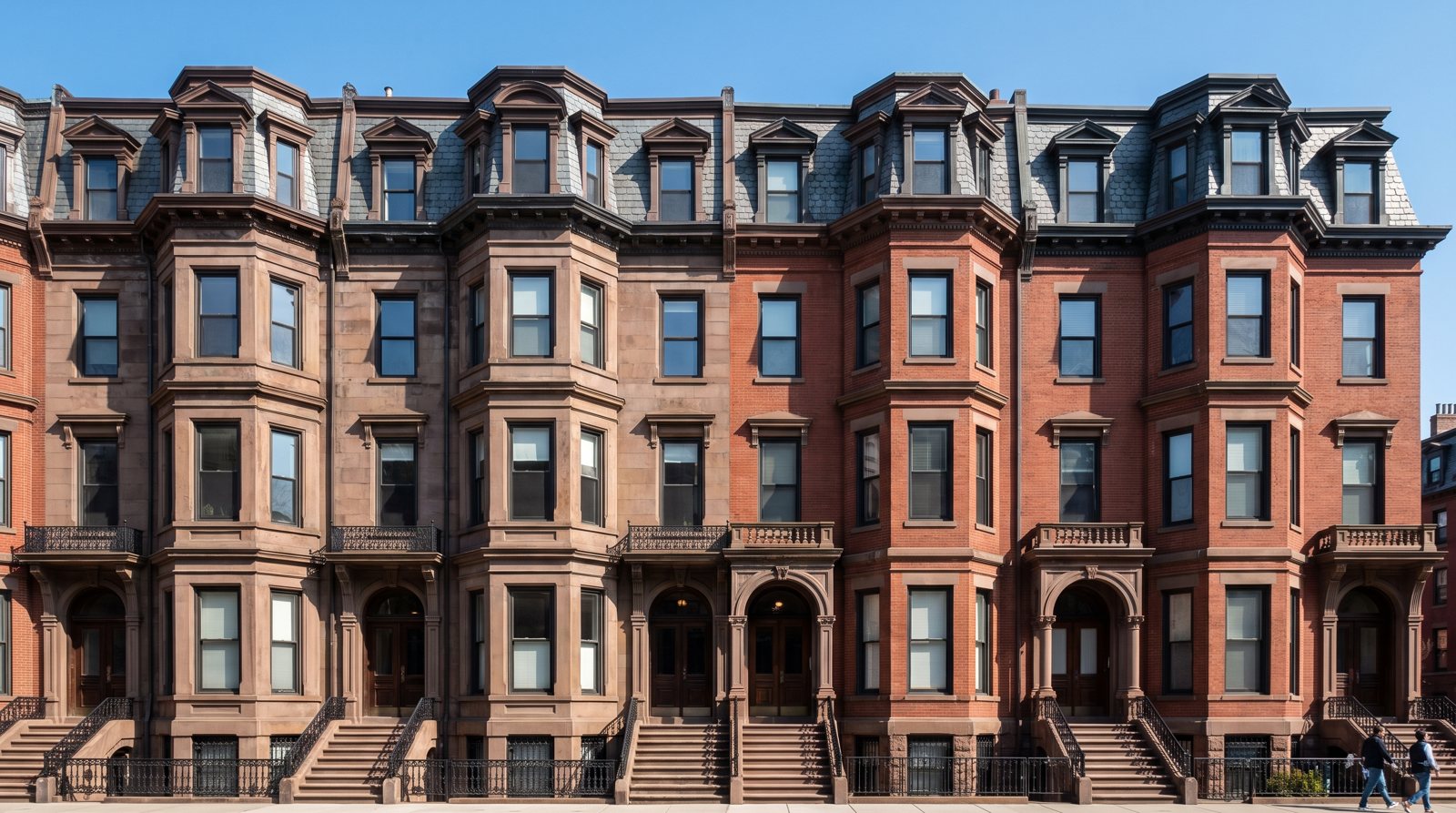
Every Back Bay brownstone home is taxed at the residential rate, whether it is a single-family townhouse or a condo unit inside a converted rowhouse. A condo unit is assessed and billed on its own. The city's FY27 budget page restates the same two FY2026 rates.
Commercial, industrial and personal property rate
Offices, shops and the ground-floor retail on streets such as Newbury and Boylston pay the commercial rate of $26.96, more than twice the residential rate.
How the levy is split
For FY2026 the City Council chose the minimum residential factor allowed by the Commissioner of Revenue under M.G.L. c. 40, s. 56, which is the largest shift onto commercial property that current state law permits. Even so, the net levy for FY2026 was split 46% residential and 54% commercial, industrial and personal property. The FY27 budget puts the net property tax levy at $3.61 billion, 73.1% of city revenue, on a total assessed value of $228.6 billion.
How does the Boston residential exemption work?
The residential exemption removes a fixed slice of assessed value from the tax bill of an owner who lives in the home as a principal residence. Because it is a flat dollar amount of value rather than a percentage, it saves the same number of dollars on a $900,000 condo as on a $3 million townhouse.
How much it saves
For FY2026 the exemption took $351,108 off the assessed value of a qualifying home. At $12.40 per $1,000 that equals $4,353.74, the maximum FY2026 saving the City of Boston states for the exemption. The Council set the exemption at 35% of the average assessed value of all residential parcels, the maximum allowed under M.G.L. c. 59, s. 5C.
Who qualifies
For FY2027, you must have a deed recorded at the Suffolk County Registry of Deeds and occupy the property as your principal residence between January 1 and June 30, 2026. An owner who buys later in 2026 would generally look to the following fiscal year. A second home or a unit you rent out does not qualify.
How and when to apply
Applications can be downloaded from the Boston Property Lookup tool (under Abatements/Exemptions) after third-quarter bills go out in late December, and are filed with the Assessing Department, Room 301, 1 City Hall Square, Boston, MA 02201. The FY2027 application deadline is April 1, 2027. The general rule is April 1, or three months after the actual bills are mailed, if that is later.
One property and the 10% floor
You can claim the exemption on only one property. Combined exemptions generally cannot reduce taxable value below 10% of the assessed value, which matters only for low-assessed homes, not for typical Back Bay values.
Example bills on a 02116 condo and house
These examples use Zillow's typical home values for ZIP 02116, Back Bay's main ZIP code, for August 2026: $1,298,982 for a condo and $1,818,983 for a single-family home. Your bill uses your assessed value from Boston Assessing, set as of January 1, which is usually different from what the home would sell for. Treat these as illustrations of the method, not as your bill.
The formula with the exemption is (assessed value minus $351,108) x $12.40 / 1,000. Without it, the full value is taxed.
| FY2026 example | 02116 condo ($1,298,982) | 02116 single-family ($1,818,983) |
|---|---|---|
| Annual tax with the residential exemption | $11,753.64 | $18,201.65 |
| Per quarter, with exemption | $2,938.41 | $4,550.41 |
| Annual tax without the exemption | $16,107.38 | $22,555.39 |
| Per quarter, without exemption | $4,026.85 | $5,638.85 |
| Difference | $4,353.74 | $4,353.74 |
| CPA surcharge, with exemption | $105.14 | $169.62 |
| CPA surcharge, without exemption | $148.67 | $213.15 |
02116 condo
For an owner-occupied condo at $1,298,982: $1,298,982 minus $351,108 leaves $947,874 of taxable value, and $947,874 x 12.40 / 1,000 = $11,753.64 a year. If the unit is a second home or rented out, the bill is $1,298,982 x 12.40 / 1,000 = $16,107.38. Condo fees are separate from the tax bill; ask the condo trust what its monthly charge covers.
02116 single-family house
For an owner-occupied townhouse at $1,818,983, taxable value is $1,467,875 and the bill is $18,201.65 a year. Without the exemption it is $22,555.39. For comparison, the city's own illustration of a $1,500,000 owner-occupied assessment comes to $14,246.26 with the exemption and $18,600 without.
Use the estimator above to run the same FY2026 rate and exemption on your own assessed value. To see how the tax sits beside a mortgage payment and condo fee, the monthly cost calculator for a Back Bay purchase applies the same figures.
What is the Community Preservation Act surcharge?
Boston adds a Community Preservation Act (CPA) surcharge of 1% on top of the property tax. It is not 1% of the full bill. The city deducts $100,000 from the property's value, recalculates the tax, applies the residential exemption and any personal exemptions, and takes 1% of that revised net tax. The surcharge is split across the four quarterly bills.
On the 02116 condo example with the exemption: $1,298,982 minus $100,000 minus $351,108 leaves $847,874, which is taxed at $10,513.64; 1% of that is $105.14 a year. Low- and moderate-income households can apply for a CPA exemption; for FY2026 the limits included $90,104 for a single non-senior household and $112,630 for a single senior (60+) household.
How does Proposition 2½ limit Boston's property tax?
Massachusetts does not set Boston's tax rate. The city decides how much to raise, and state law, M.G.L. c. 59, s. 21C (Proposition 2½), caps it. The rate is what results when that levy is divided across assessed values, which is why a rising market can bring a lower rate without lowering bills.
The 2.5% levy limit
Each year a city's total property tax may grow to no more than 102.5% of the previous year's levy limit, plus new growth: the prior year's rate applied to the value of new construction and other newly taxable property. Separately, total taxes may never exceed 2.5% of the full and fair cash value of all property in the city. Boston's FY2026 residential rate of $12.40 per $1,000 is 1.24% of value.
Overrides and exclusions
Raising the levy above the limit takes a vote of the local appropriating authority and then a majority of voters at an election. Debt and capital outlay exclusions need a two-thirds vote of the appropriating authority and a majority of voters, and the amounts excluded do not count toward the levy limit.
Within the levy, the split between homes and businesses is what has moved Back Bay bills most in recent years, as the section on FY2027 timing below explains.
How are Boston assessments and abatements handled?
January 1 assessment date
Boston values every property as of January 1 for the following fiscal year. Renovations, a condo conversion or a market change after that date show up a year later. You can look up your assessed value, and the property's record, in Boston Property Lookup.
Filing an abatement
If you believe the assessment is too high, you can apply for an abatement. For FY2027, the application can be filed only after the third-quarter bill is issued and no later than February 1, 2027, and only for the current fiscal year. Start by checking the property record for errors, such as square footage or unit count, and gather sales of comparable homes from around January 1. If you are weighing a sale, the same comparable sales also inform pricing a Back Bay home for sale.
Appeals to the Appellate Tax Board
Boston Assessing has three months to decide an abatement application. If you disagree with the decision, you have three months from it to appeal to the Massachusetts Appellate Tax Board.
Personal exemptions
Separate personal exemptions exist for qualifying elderly owners, blind persons, surviving spouses, minor children of deceased parents, veterans and National Guard members. A Boston tax law firm's guide lists them by clause of M.G.L. c. 59, s. 5: Clause 41C for qualifying seniors who meet age, income and asset limits, Clause 37A for blind owners, Clause 17D for surviving spouses, minor children of deceased parents and some elderly owners, Clause 18 for hardship, and Clause 22 for veterans. The city's veterans exemption page lists $423 for veterans with a service-connected disability of at least 10%, with higher categories of $793 to $1,586; confirm the fiscal year and eligibility with Assessing.
When are Boston property tax bills due?
Boston bills quarterly. The first two bills are estimates, each half of the previous year's tax; the actual rate and value first appear on the third-quarter bill.
| Bill | Issued | Due | Based on |
|---|---|---|---|
| Q1 preliminary | July 1 | August 1 | Prior year's tax |
| Q2 preliminary | October 1 | November 1 | Prior year's tax |
| Q3 actual | Late December | February 1 | Current value and rate |
| Q4 actual | April 1 | May 1 | Current value and rate |
Due dates move to the next business day when they fall on a weekend or holiday. If you have a mortgage with an escrow account, your lender pays these bills from it. At a sale, the attorneys prorate the current bill between buyer and seller, one of the items covered in Massachusetts closing costs for buyers and sellers.
How to pay your Boston tax bill
The City of Boston takes payment online by card or checking account, by phone, by mail (check or money order with the bill stub) and in person at City Hall. Card payments carry a non-refundable fee: 2.75% online with a $1 minimum, or 2.5% in person; online payment from a checking account has no service fee. The city warns that unpaid taxes can result in a lien against the property.
When will Boston's FY2027 tax rates be set?
As of October 7, 2026, FY2027 rates and the FY2027 exemption amount have not been published. Under the assessing calendar, the actual rate first appears on the third-quarter bill issued in late December 2026. Until then, the July and October 2026 bills are estimates based on FY2026, and the FY2026 figures on this page are the latest published.
The FY2026 tax shift news
Boston's residential share of the levy has been rising as office values fall. The Dorchester Reporter reported in December 2025 that the city projected residential values up 6% and commercial values down 2% for FY2026, with the residential share of the levy at 46.1%, up from 41.7% in FY2024. The city projected a 13% increase, about $780, for the average single-family homeowner receiving the residential exemption, after a 10.4% increase in FY2025.
Mayor Wu's home rule petition to shift more of the levy to commercial property temporarily was approved by the City Council and twice by the Massachusetts House, but it is not law. WBUR reported that on January 15, 2026 the State Senate rejected an amendment mirroring the proposal by 33 to 5, and instead passed a bill letting cities and towns offer targeted credits in years when property taxes rise more than 10%. Whether that bill becomes law depends on the House; check the current status before relying on it.
What to confirm before you rely on these numbers
Property tax is one line in the cost of owning in Back Bay; the full cost of owning a Back Bay home sets it beside condo fees, insurance and utilities. Values differ street by street, so the guide to Back Bay's streets is the better place to see what kind of home sits where.
- Your assessed value and property record: Boston Property Lookup, or Boston Assessing at 617-635-4287.
- Exemption eligibility and the April 1 deadline: Boston Assessing or the Taxpayer Referral and Assistance Center.
- The FY2027 rate and exemption: published with the late-December 2026 bills.
- How property tax affects your income tax: a Massachusetts CPA.
This page explains how the tax works; it is not tax advice. Confirm the figures for your home with Boston Assessing or a Massachusetts CPA before you budget around them. For the other recurring costs of owning here, read the cost of living in Back Bay.
Frequently asked questions
What is the property tax rate in Boston?
For fiscal year 2026, Boston's residential property tax rate is $12.40 per $1,000 of assessed value, and the commercial, industrial and personal property rate is $26.96 per $1,000. Owner-occupants who qualify for the residential exemption are taxed on their assessed value minus $351,108, which saves up to $4,353.74. FY2027 rates are set in December 2026 and appear on the third-quarter bill.
Are taxes high in Boston?
Boston's FY2026 residential rate is $12.40 per $1,000, but bills in Back Bay are large because values are high. At Zillow's August 2026 typical 02116 condo value of $1,298,982, an owner-occupant would pay $11,753.64 a year with the residential exemption and $16,107.38 without it, plus the CPA surcharge. Your bill depends on your assessed value, not the market value.
How much will the property tax increase in Boston be in 2026?
For FY2026, the city projected a 13% increase, about $780, for the average single-family homeowner receiving the residential exemption, after 10.4% in FY2025, according to the Dorchester Reporter. Your own change depends on your assessed value. FY2027 rates are not yet published; they appear on the third-quarter bill issued in late December 2026.
How do I apply for the Boston residential exemption?
Download the application from Boston Property Lookup under Abatements/Exemptions after third-quarter bills are issued in December, and file it with the Assessing Department, Room 301, 1 City Hall Square, Boston, MA 02201. For FY2027 you must have recorded a deed and occupied the home as your principal residence between January 1 and June 30, 2026. The deadline is April 1, 2027.
Is my assessed value the same as my home's market value?
No. Boston Assessing values each property as of January 1 for the following fiscal year, and the tax is calculated on that assessed value. A recent sale price, a listing price or Zillow's typical value can be higher or lower. Check your assessment in Boston Property Lookup, and file for an abatement by February 1, 2027 if you believe it is wrong.
When are Boston property tax bills due?
Boston bills quarterly. Preliminary bills issued July 1 and October 1 are due August 1 and November 1. The actual third-quarter bill is issued in late December and due February 1, and the fourth-quarter bill is issued April 1 and due May 1. Due dates move to the next business day if they fall on a weekend or holiday.
How much are property taxes on a $300,000 house?
In Boston, a home assessed at $300,000 is taxed $3,720 a year at the FY2026 residential rate of $12.40 per $1,000, without the residential exemption. For an owner-occupant, the FY2026 exemption of $351,108 is larger than the value itself, and the city's rule that exemptions generally cannot cut taxable value below 10% of the assessment then applies. Confirm the exact bill with Boston Assessing.
Is Massachusetts raising taxes?
Property tax is set by each city or town, not by the state. Proposition 2½ (M.G.L. c. 59, s. 21C) lets a community's levy grow by 2.5% a year plus new growth, and more only if voters approve an override. Boston's FY2027 rates are not yet published; they appear on the third-quarter bill in late December 2026.
Sources
- City of Boston Assessing: How we tax your property
- City of Boston Assessing: Residential exemption
- Jamaica Plain Gazette: FY 2026 Boston residential tax exemption can save you up to $4,353.74 (Jan 22, 2026)
- Boston City Council: Order relative to the adoption of tax classification in FY 2026
- City of Boston Budget: FY27 property taxes
- City of Boston Assessing: Assessing calendar
- City of Boston Assessing: How to file a real estate tax abatement
- City of Boston Assessing: Community Preservation Act
- City of Boston Assessing: Veterans exemption 22
- City of Boston: Mayor Wu's 2026 property tax relief calculator
- Dorchester Reporter: Wu renews call for Legislature to act on city tax measure (Dec 3, 2025)
- WBUR: Massachusetts Senate rejects Boston Mayor Michelle Wu's tax-shift proposal (Jan 15, 2026)
- Zillow Research: Home Value Index (ZHVI) data, August 2026
- malegislature.gov: M.G.L. c. 59, Section 21C (Proposition 2½)
- City of Boston Tax Collection: How to pay your real estate taxes
- Segal, Cohen & Landis: Tax relief in Boston (Jan 2, 2026)